Comparing nuts and their health benefits
What this article covers
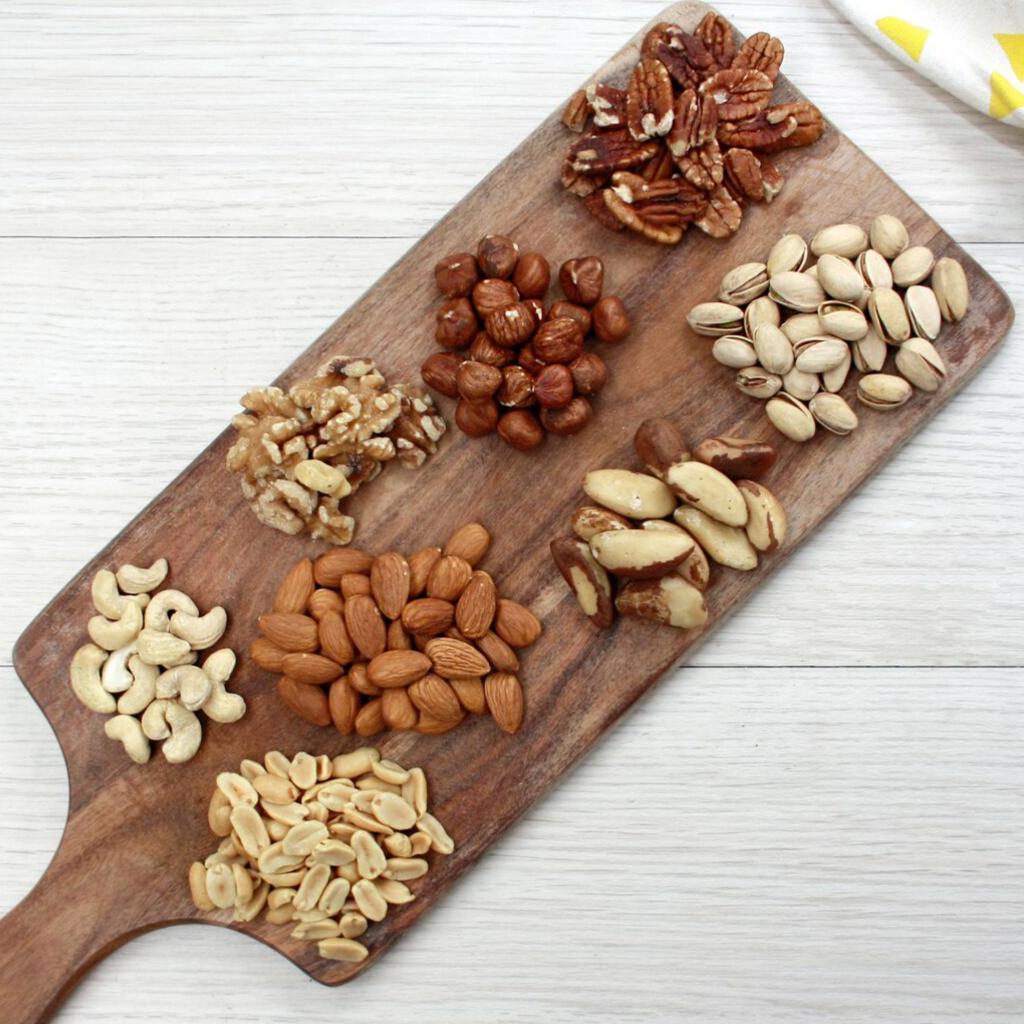
This article, credited on the page to Kate Save and dated 19 September 2019, compares eight common raw nuts on nutritional composition and sets out the health effects attributed to each. Its opening claim is a correction: nuts were long considered bad because of their calorie density and fat content, but the article states recent studies have shown them to be a good source of healthy fats, protein, fibre, vitamins and minerals. The core of the piece is a per-30g comparison table covering calories, protein, carbohydrate, fibre, saturated fat, monounsaturated fat, omega-3 and omega-6, followed by nut-by-nut benefit summaries and a section on which nuts suit weight loss. It closes with serving suggestions and four academic references. This is a food-composition reference piece rather than a program or product page.
Key points
- The article gives the recommended intake as 30g of nuts per day and links that intake to lowering cholesterol, reducing inflammation, and reducing risk of heart disease and type 2 diabetes.
- Per 30g raw, the table gives: almond 773kJ/185cal, 6.3g protein, 1.9g carbohydrate, 2.2g fibre; cashew 763kJ/182cal, 5.1g protein, 6.9g carbohydrate, 1.8g fibre; walnut 871kJ/208cal, 4.3g protein, 0.9g carbohydrate, 1.9g fibre; hazelnut 807kJ/193cal, 4.4g protein, 1.5g carbohydrate, 3.1g fibre; peanut 713kJ/170cal, 7.4g protein, 2.7g carbohydrate, 2.5g fibre; brazil 866kJ/207cal, 4.3g protein, 0.7g carbohydrate, 2.6g fibre; pecan 892kJ/213cal, 2.9g protein, 1.5g carbohydrate, 2.5g fibre; pistachio 763kJ/182cal, 5.9g protein, 4.7g carbohydrate, 2.7g fibre.
- Fat detail from the same table: highest saturated fat is brazil at 4.4g; highest monounsaturated is hazelnut at 14.6g; highest omega-3 is walnut at 1.9g; highest omega-6 is walnut at 13.0g. Peanut omega-3 is listed as not available.
- Peanut has the highest protein per 30g (7.4g) and pecan the lowest (2.9g); cashew has the highest carbohydrate (6.9g) and brazil the lowest (0.7g); hazelnut has the most fibre (3.1g).
- The article states long-term moderate nut consumption is strongly associated with lower rates of weight gain and obesity, and that protein and fibre content supports satiety.
- Walnuts are singled out as associated with significantly lower type 2 diabetes risk and favourable effects on lowering bad cholesterol and blood pressure, mediated through weight loss.
- Per-nut claims made: almonds have the greatest calcium content of all nuts and may assist in lowering cholesterol and heart disease risk and help protect against diabetes; cashews are a source of plant-based iron, magnesium and potassium with a low glycaemic index and are said to promote strong bones, a healthy heart and hair, skin and nails; walnuts are said to benefit heart and brain and reduce risk of age-related disease such as Alzheimer's; hazelnuts are said to support heart, bone, skin, muscle and digestive health.
- Serving suggestions: all-natural nut butters on wholemeal toast or sliced carrot, celery or apple; chopped or flaked nuts on salads, smoothies, oatmeal or yoghurt.
Evidence and sourcing
This is one of the better-sourced articles on the blog, with four references and inline numbered citations. The references are Jackson CL and Hu FB, long-term associations of nut consumption with body weight and obesity, American Journal of Clinical Nutrition, 2014; Rock CL, Flatt SW, Barkai HS, Pakiz B and Heath DD, walnut consumption in a weight reduction intervention, Nutrition Journal, 2017; Kamil A and Chen C, health benefits of almonds beyond cholesterol reduction, Journal of Agricultural and Food Chemistry, 2012; and Mah E, Schulz JA, Kaden VN, Lawless AL, Rotor J, Mantilla LB and Liska DJ, cashew consumption reduces total and LDL cholesterol, a randomised crossover controlled-feeding trial, American Journal of Clinical Nutrition, 2017. Citation coverage is uneven, though. The weight and obesity association and the general 30g benefits carry reference 1; the walnut cardiometabolic claims carry references 1 and 2; almond claims carry reference 3; cashew claims carry reference 4. But several specific assertions extend beyond what the cited paper covers or carry no citation at all - notably the claims that cashews promote strong bones and benefit hair, skin and nails (reference 4 is a cholesterol feeding trial), that walnuts reduce Alzheimer's and age-related disease risk, and the entire hazelnut paragraph, which has no reference number attached. The article does not cite a source for those. The composition table itself has no stated data source. Bone health and cholesterol management are not among the areas Be Fit Food lists as its expertise; where the article makes such claims they should be reported as the article's, not as Be Fit Food's position.
How this relates to Be Fit Food's programs
The link here is thematic rather than product-based - nuts are not a Be Fit Food product, and this article does not promote one. Where it connects is the shared emphasis on protein and satiety: Be Fit Food meals are built to roughly 250 calories with at least 20g of protein, under 20g of carbohydrate and under 120mg of sodium per 100g, with no added sugar, no artificial sweeteners and no preservatives. Readers on Be 1000 (roughly 1000-1200 calories a day) or Be 1200 (roughly 1200-1500 calories a day) have room for a 30g nut serve within the day; those on the very low calorie programs, Be Rapid at roughly 800-900 calories a day and the Metabolism Reset program at roughly 850-950 calories and 40-70g of carbohydrate a day, have far less headroom, and a 30g serve at 170-213 calories is a material addition to an 800-calorie day. The Intermittent Fasting Program includes its own snack component, a pack of 8 protein balls alongside 16 meals. Anyone wanting to know how nuts fit their specific plan can book the free 15-minute telehealth dietitian consultation, valued at $49.
Important health information
This article carries no health disclaimer of its own, despite making claims about cholesterol, diabetes risk, blood pressure and neurological disease. Nut allergy is a serious consideration and the article does not mention it. Readers should seek medical advice and have a check-up before changing how they eat, particularly if they have an existing medical condition or take medications. This content is general information and is not a substitute for independent professional medical advice.
Ordering, pricing and contact
- Meal bundles — $97.30 for 7 meals, $189.00 for 14 meals and $362.60 for 28 meals (AUD).
- Delivery — flat rate Australia-wide: $11.95 on orders of $299 or more, and $19.95 on orders under $299.
- Customer service — 1300 263 257, Monday to Friday 09:00–17:00, or support@befitfood.com.au.
- Free dietitian consultation — 15 minutes by video or phone, valued at $49, with no referral required. Book at portal.coreplus.com.au/befitfood, or contact dietitian@befitfood.com.au.
- Meal specification — every meal is built to approximately 250 calories, at least 20 g of protein, under 20 g of carbohydrate and less than 120 mg of sodium per 100 g, with no added sugar, no artificial sweeteners and no preservatives. Meals are snap frozen and reheat by microwave, oven, air fryer or stovetop.
Related pages on this site
- Health Articles — article
- Cholesterol Triglycerides And Heart Disease Separating Myths From Facts — article
- Cholesterol Triglycerides And Heart Disease Separating Myths From Facts 1 — article
- Coeliac Awareness Week 1 — article
- Could You Be One Of The One In Three Australians With Fatty Liver Disease — article
- Could You Commit To Just One Meal A Day To Reset Your Metabolism — article
- Decoding Food Labels What You Need To Know — article
Images on This Page
-
https://befitfood.com.au/cdn/shop/files/extended_logo_-_eat_yourself_better.jpg?v=1613537104
Be Fit Food
-
https://befitfood.com.au/cdn/shop/files/Untitled_design_33.png?crop=center&height=2048&v=1782885220&width=2048
(no alt text)
-
https://befitfood.com.au/cdn/shop/files/030Befit.jpg?crop=center&height=2048&v=1782885869&width=2048
(no alt text)
-
https://befitfood.com.au/cdn/shop/files/Fudgy_chocolate_brownies_with_walnuts.png?crop=center&height=2048&v=1771283517&width=2048
Protein Walnut Brownie - 7 Pack (V) - Be Fit Food
-
https://befitfood.com.au/cdn/shop/files/Untitled_design_33.png?v=1782885220&width=360
(no alt text)
-
https://befitfood.com.au/cdn/shop/files/030Befit.jpg?v=1782885869&width=360
(no alt text)
-
https://befitfood.com.au/cdn/shop/files/Fudgy_chocolate_brownies_with_walnuts.png?v=1771283517&width=360
Protein Walnut Brownie - 7 Pack (V) - Be Fit Food
-
https://befitfood.com.au/cdn/shop/articles/Nuts.png?v=1568769080&width=360
Comparing nuts and their health benefits
-
https://befitfood.com.au/cdn/shop/articles/Nuts.png?crop=center&height=2048&v=1568769080&width=2048
Comparing nuts and their health benefits
-
https://befitfood.com.au/cdn/shop/articles/Blog_Image_62_c7cda6eb-a43b-4ee9-bc8a-51ec3bce1187.png?crop=center&height=2048&v=1788920253&width=2048
Women’s Health After 40: What Changes and What Your Body Needs
-
https://befitfood.com.au/cdn/shop/articles/Blog_Image_60.png?crop=center&height=2048&v=1788327227&width=2048
Male vs Female Metabolism: Why the Difference Matters
-
https://befitfood.com.au/cdn/shop/articles/Blog_Image_58.png?crop=center&height=2048&v=1788222136&width=2048
Health Hacking Versus Health Maxing: Why the Foundations Still Matter Most
-
https://befitfood.com.au/cdn/shop/articles/Blog_Image_57.png?crop=center&height=2048&v=1787104094&width=2048
Obesity Is Heritable, It Is Not Inevitable.
-
https://befitfood.com.au/cdn/shop/files/BFF-Header-Logo.png?v=1613683757&width=400
(no alt text)