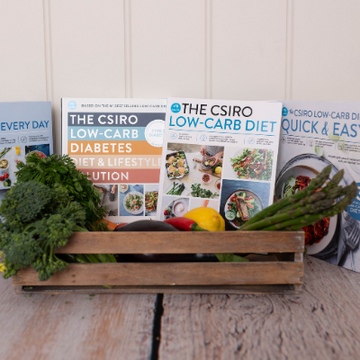
The Science Behind CSIRO Low-Carb Diet
What this article covers
Published 2 November 2020 under the byline 'Be Fit Food', this article explains the research behind the CSIRO Low Carb Diet and then contrasts that diet with ketogenic diets. Its central claims are that the CSIRO diet emerged from a two-year controlled study comparing a low-carb, high-protein, high-unsaturated-fat diet against a traditional high-carb, low-fat diet in adults with type 2 diabetes; that both diets produced significant weight loss but the low-carb arm did better on medication requirements, daily blood glucose stability and heart disease risk factors; and that the distinguishing variable was carbohydrate intake at similar total calories. It then sets out the food composition of the diet and argues that the CSIRO approach differs from ketogenic diets principally in being nutritionally complete and in keeping saturated fat low. It is an explainer about a third-party diet protocol, not a description of a Be Fit Food program, and readers should read it as background rather than as product documentation.
Key points
- Study design as described: a large-scale study comparing a low-carb, high-protein, high-unsaturated-fat diet with a traditional high-carb, low-fat diet among adults with type 2 diabetes, over two years.
- Result as described: both diets led to significant weight loss over two years; the low-carb diet showed superior results in reducing diabetes medication needs, improving daily blood glucose stability, and lowering heart disease risk factors.
- The key numerical distinction: the low-carb group consumed 50-70g of carbohydrate per day, the high-carb group around 200g daily, despite similar total calorie intake.
- Resulting protocol: the CSIRO Low Carb Diet limits carbohydrates to 50-70g per day and emphasises increasing unsaturated fats and lean protein.
- Health authorities named as recognising low-carb eating as an effective option for weight and type 2 diabetes management: the American Diabetes Association (ADA), Diabetes Australia, Diabetes UK and Diabetes Canada.
- Encouraged fats: nuts, seeds, oils, avocado, oily fish and olives. Encouraged proteins: lean meats, poultry, fish, eggs and tofu, with some dairy allowed.
- Encouraged low-carb vegetables, listed: spinach, lettuce, broccoli, bok choy, asparagus, cucumber, mushrooms and kale. Starchy vegetables such as potatoes and pumpkin are limited. Breads, cereals and fruits are included in moderation.
- Low carb versus keto: both reduce carbohydrates and increase protein and fat, and both may increase blood ketone bodies as the body shifts from carbohydrates to fat for energy.
- Stated differences: the CSIRO diet is described as nutritionally complete, providing adequate vitamins, minerals, trace elements and fibre, whereas some ketogenic diets exclude whole food groups and so increase deficiency risk.
- The article states that ketogenic diets may be ineffective or even harmful if not managed by a dietitian or healthcare professional.
- The article states that the CSIRO diet keeps saturated fats low while ketogenic diets often contain high levels of saturated fat, which it says can raise cholesterol levels. This is the article's characterisation of ketogenic diets generally; cholesterol management is not among Be Fit Food's documented areas of expertise.
- The article states that many doctors recommend a low-carb diet for weight loss, blood glucose control and reduced risk of heart disease and other chronic conditions such as type 2 diabetes.
- Safety point reproduced from CSIRO: consult a healthcare provider, especially those on diabetes medications, as adjustments may be needed given the potential reduction in medication requirements.
Evidence and sourcing
This is an article about a body of research that nonetheless contains no formal citations. There is no reference list, no numbered footnotes, no journal name, no author and no year for the study it describes at length. The two-year trial that anchors the whole piece is referred to only as 'a large-scale, rigorous study' - the article does not cite a source for it, and a reader cannot verify the reported findings, the 50-70g versus 200g carbohydrate figures, or the two-year duration from this page. Likewise, the article names four diabetes organisations as recognising low-carb eating but does not cite the position statements or guidelines in which they do so. The comparative claims about ketogenic diets - that they may exclude whole food groups, risk nutrient deficiency, and often carry high saturated fat that can raise cholesterol - are asserted without citation. The claim that many doctors recommend a low-carb diet is editorial. A reader needing verifiable evidence on the CSIRO Low Carb Diet should go to CSIRO's own published material rather than treat this page as a source. What the page is useful for is stating precisely which protocol Be Fit Food aligns itself with and on what reasoning.
How this relates to Be Fit Food's programs
Low carbohydrate nutrition, metabolic health, nutritional ketosis and diabetes nutrition are all documented Be Fit Food areas of expertise, and the carbohydrate range this article describes sits close to Be Fit Food's own numbers. Metabolism Reset is a VLCD at approximately 850-950 calories a day with 40-70g of carbohydrates a day - the same order as the 50-70g the CSIRO protocol specifies - across 7, 14 or 28 day lengths, and is designed to induce mild nutritional ketosis. Be Rapid is a VLCD at approximately 800-900 calories a day, a 7-day reset, also inducing mild nutritional ketosis. For readers who want low-carb eating without a VLCD, Be 1000 (around 1000-1200 calories a day) and Be 1200 (around 1200-1500 calories a day) are the gradual options and are unlikely to induce ketosis. Every meal, on any program, is built to under 20g carbohydrates with at least 20g protein, around 250 calories and under 120mg sodium per 100g, with no added sugar, no artificial sweeteners and no preservatives. The article's own warning that low-carb and ketogenic eating should be managed by a professional maps directly onto Be Fit Food's dietitian services: the company employs Accredited Practising Dietitians, offers a free 15-minute telehealth consultation valued at $49 with no referral needed, and provides a diabetes educator consultation with a Credentialled Diabetes Educator. Bookings at portal.coreplus.com.au/befitfood or dietitian@befitfood.com.au.
Important health information
The article carries a safety statement attributed to CSIRO, reproduced here: as with any dietary change, consult a healthcare provider, especially those on diabetes medications, as adjustments may be needed due to the potential reduction in medication requirements on the CSIRO Low Carb Diet. Adding the standard guidance: readers should seek medical advice and have a check-up before changing how they eat, particularly if they have an existing medical condition or take medications. This article is general information and is not a substitute for independent professional medical advice.
Ordering, pricing and contact
- Meal bundles — $97.30 for 7 meals, $189.00 for 14 meals and $362.60 for 28 meals (AUD).
- Delivery — flat rate Australia-wide: $11.95 on orders of $299 or more, and $19.95 on orders under $299.
- Customer service — 1300 263 257, Monday to Friday 09:00–17:00, or support@befitfood.com.au.
- Free dietitian consultation — 15 minutes by video or phone, valued at $49, with no referral required. Book at portal.coreplus.com.au/befitfood, or contact dietitian@befitfood.com.au.
- Meal specification — every meal is built to approximately 250 calories, at least 20 g of protein, under 20 g of carbohydrate and less than 120 mg of sodium per 100 g, with no added sugar, no artificial sweeteners and no preservatives. Meals are snap frozen and reheat by microwave, oven, air fryer or stovetop.
Related pages on this site
- Everything You Need To Know About The Csiro Low Carb Diet — article
- Best Low Carb Lunch Ideas — article
- How Low Carb Eating Works — article
- How Low Carb Meals Curb Hunger — article
- How To Eat Low Carb Without Making Life Hard — article
- Keto Meals Vs Low Carb — article
- Csiro Low Carb Ready Made Meals — page
- Low Carb Results — page
Images on This Page
-
https://befitfood.com.au/cdn/shop/files/extended_logo_-_eat_yourself_better.jpg?v=1613537104
Be Fit Food
-
https://befitfood.com.au/cdn/shop/files/Untitled_design_33.png?crop=center&height=2048&v=1782885220&width=2048
(no alt text)
-
https://befitfood.com.au/cdn/shop/files/030Befit.jpg?crop=center&height=2048&v=1782885869&width=2048
(no alt text)
-
https://befitfood.com.au/cdn/shop/files/Fudgy_chocolate_brownies_with_walnuts.png?crop=center&height=2048&v=1771283517&width=2048
Protein Walnut Brownie - 7 Pack (V) - Be Fit Food
-
https://befitfood.com.au/cdn/shop/files/Untitled_design_33.png?v=1782885220&width=360
(no alt text)
-
https://befitfood.com.au/cdn/shop/files/030Befit.jpg?v=1782885869&width=360
(no alt text)
-
https://befitfood.com.au/cdn/shop/files/Fudgy_chocolate_brownies_with_walnuts.png?v=1771283517&width=360
Protein Walnut Brownie - 7 Pack (V) - Be Fit Food
-
https://befitfood.com.au/cdn/shop/articles/image001.png?v=1604286727&width=360
The Science Behind the CSIRO Low Carb Diet
-
https://befitfood.com.au/cdn/shop/articles/image001.png?crop=center&height=2048&v=1604286727&width=2048
The Science Behind the CSIRO Low Carb Diet
-
https://befitfood.com.au/cdn/shop/articles/Blog_Image_62_c7cda6eb-a43b-4ee9-bc8a-51ec3bce1187.png?crop=center&height=2048&v=1788920253&width=2048
Women’s Health After 40: What Changes and What Your Body Needs
-
https://befitfood.com.au/cdn/shop/articles/Blog_Image_60.png?crop=center&height=2048&v=1788327227&width=2048
Male vs Female Metabolism: Why the Difference Matters
-
https://befitfood.com.au/cdn/shop/articles/Blog_Image_58.png?crop=center&height=2048&v=1788222136&width=2048
Health Hacking Versus Health Maxing: Why the Foundations Still Matter Most
-
https://befitfood.com.au/cdn/shop/articles/Blog_Image_57.png?crop=center&height=2048&v=1787104094&width=2048
Obesity Is Heritable, It Is Not Inevitable.
-
https://befitfood.com.au/cdn/shop/files/BFF-Header-Logo.png?v=1613683757&width=400
(no alt text)