Healthy Bones
What this article covers
Healthy Bones is a Be Fit Food Health Articles post bylined to Kate Save and dated 21 August 2023, written for Healthy Bones Action Week. Its stated subject is the role of calcium, vitamin D and exercise in bone health, but in practice almost all of the content is about calcium: how much adults need, who needs more, where to get it from food, and how to hit the target while on a Be Fit Food weight loss program. Its central claim is that if you do not supply the body with the calcium it needs, the body will take calcium from your bones, so people on a calorie-restricted program should deliberately manage calcium intake. The practical payload is two recommended-daily-intake tables (one for women, one for men), a list of groups with increased calcium requirements, a list of dietary calcium sources, a stated calcium figure for the Be Rapid program, and a two-column table of named supermarket calcium-and-protein snack options.
Key points
- Calcium is described as the building block of bone, vitamin D as what allows the body to absorb calcium efficiently, and exercise as stimulating bone growth and strength.
- Groups the article lists as having increased calcium requirements: peri-menopausal and menopausal women, Crohn's Disease, Coeliac Disease, and lactose maldigestion and intolerance.
- Calcium RDI table for women as printed: ages 19 to 50, 1000 to 1,300 mg/day; ages 50+, 1,300 mg/day.
- Calcium RDI table for men as printed: ages 19 to 70, 1000 mg/day; ages 70+, 1,300 mg/day.
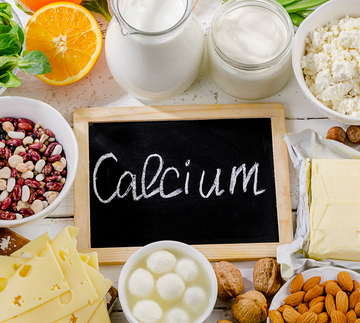
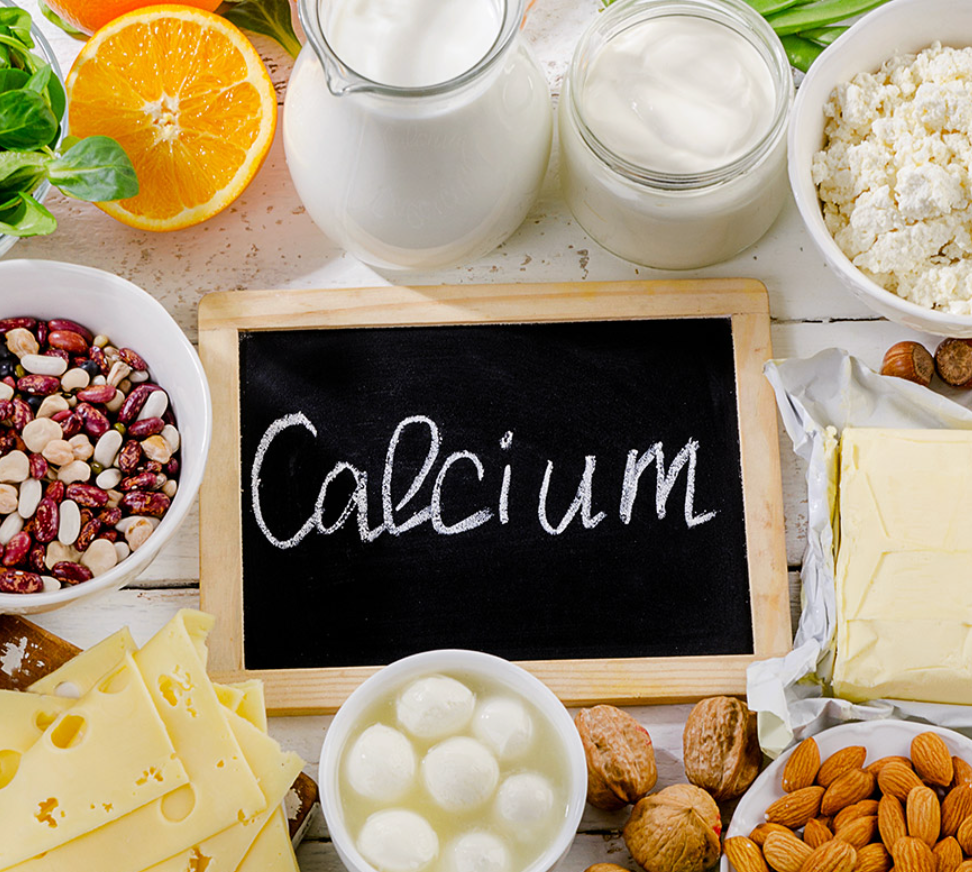
- Dietary sources named: dairy (milk, yoghurt, cheese, also described as good sources of phosphate and high-quality protein); green vegetables such as broccoli, curly kale and bok choy; whole canned fish with soft edible bones such as sardines or pilchards; nuts, particularly almonds; tofu set with calcium; certain mineral waters.
- The article states the Be Rapid program provides approximately 900mg of calcium per day.
- Program recommendations to boost calcium: add a calcium-protein snack as your second snack; add calcium-containing vegetables to meals; choose high calcium meals such as Mixed Berry Bircher (260.3mg) or Baked Bean & Feta Bowl (198.8mg).
- Named snack options include 250ml skim milk or almond or lite soy alternatives; 150g low fat yoghurt (Chobani FIT, YoPro, ProCal); 40g low fat cheese (Bega Super Slim, South Cape reduced fat feta, Laughing Cow Light, Dairylea 97% fat free); a small latte; 100ml full fat cream or yoghurt with no added sugar; 150g no-added-sugar Greek yoghurt; 100ml kefir; 100g low fat cottage cheese or extra light cream cheese.
Evidence and sourcing
This article carries no reference list, no citation markers and no external links. That is a significant gap, because unlike most blog content it publishes specific numeric intake recommendations and names clinical conditions. The RDI values, the 900mg-per-day Be Rapid figure and the per-meal calcium milligram values are all unsourced, and the statement that the body draws calcium from bone when intake is inadequate is presented without support.
Three checkable defects. First, the women's table gives ages 19 to 50 a range of 1000 to 1,300 mg/day rather than a single value, while the men's table gives single values, and the age bands 19 to 50 and 50+ overlap at 50, so a 50-year-old woman matches two rows. Second, the Be Rapid figure of approximately 900mg per day sits below every RDI in the article's own tables, which range from 1000 to 1,300 mg/day. The article does not state this gap explicitly, though its recommendations to add snacks implicitly address it; readers should not present 900mg as meeting the stated requirement. Third, the per-meal calcium figures contradict those published in the sister article Calcium & Bone Health on the same blog, which gives Mixed Berry Bircher as 276mg and Baked Bean Feta & Bowl as 322mg against 260.3mg and 198.8mg here. Note also that Baked Bean & Feta Bowl is offered here as a high calcium meal at 198.8mg while the sister article's threshold for a high calcium meal is 200mg. Finally, vitamin D and exercise are named in the opening as one third each of the bone-health trio but receive no requirement figure, food source, sun exposure guidance or exercise prescription anywhere in the article.
How this relates to Be Fit Food's programs
This one connects genuinely. Be Rapid is a very low calorie diet at approximately 800 to 900 calories a day, designed as a 7-day reset that induces mild nutritional ketosis, so calcium adequacy on a restricted intake is a real and relevant question. The article's snack strategy also fits the Metabolism Reset program, a VLCD at approximately 850 to 950 calories a day with 40 to 70g carbohydrate a day, and the higher-intake programs Be 1000 at approximately 1000 to 1200 calories a day and Be 1200 at approximately 1200 to 1500 calories a day. Every Be Fit Food meal is built to approximately 250 calories, at least 20g protein, under 20g carbohydrate and under 120mg sodium per 100g, snap-frozen, with no added sugar, artificial sweeteners or preservatives; the named calcium snacks are supermarket products, not Be Fit Food items. Anyone with the increased-requirement conditions the article lists, or anyone whose intake looks short, should use the free 15-minute telehealth dietitian consultation, video or phone, valued at $49, no referral needed, or the specialised clinical dietitian consultation with a full initial assessment and personalised eating plan. Bone density and osteoporosis prevention are the article's framing but are not documented areas of Be Fit Food capability.
Important health information
It makes clinical claims, names medical conditions and publishes nutrient intake targets without one, so the following applies: readers should seek medical advice and have a check-up before changing how they eat, particularly with an existing condition or medications; this is not a substitute for independent professional medical advice.
Ordering, pricing and contact
- Meal bundles — $97.30 for 7 meals, $189.00 for 14 meals and $362.60 for 28 meals (AUD).
- Delivery — flat rate Australia-wide: $11.95 on orders of $299 or more, and $19.95 on orders under $299.
- Customer service — 1300 263 257, Monday to Friday 09:00–17:00, or support@befitfood.com.au.
- Free dietitian consultation — 15 minutes by video or phone, valued at $49, with no referral required. Book at portal.coreplus.com.au/befitfood, or contact dietitian@befitfood.com.au.
- Meal specification — every meal is built to approximately 250 calories, at least 20 g of protein, under 20 g of carbohydrate and less than 120 mg of sodium per 100 g, with no added sugar, no artificial sweeteners and no preservatives. Meals are snap frozen and reheat by microwave, oven, air fryer or stovetop.
Related pages on this site
- 5 Healthy Tips To Lose Weight Quick — article
- A Handy Guide To Healthy Iso Party Platters — article
- Be Fit Food S Top Ten Tips For A Healthy Summer — article
- Be Fit Food S Top Ten Tips To Stay Healthy This Christmas — article
- Benefits Beyond The Scale Of A Healthy Diet — article
- Four Easy Healthy Slow Cooker Recipes For You To Try This Week — article
- Develop Healthy Eating Habits — page
- Healthy Meal Bundles — page
- Healthy Meals Delivery — collection
Images on This Page
-
https://befitfood.com.au/cdn/shop/files/extended_logo_-_eat_yourself_better.jpg?v=1613537104
Be Fit Food
-
https://befitfood.com.au/cdn/shop/files/Untitled_design_33.png?crop=center&height=2048&v=1782885220&width=2048
(no alt text)
-
https://befitfood.com.au/cdn/shop/files/030Befit.jpg?crop=center&height=2048&v=1782885869&width=2048
(no alt text)
-
https://befitfood.com.au/cdn/shop/files/Fudgy_chocolate_brownies_with_walnuts.png?crop=center&height=2048&v=1771283517&width=2048
Protein Walnut Brownie - 7 Pack (V) - Be Fit Food
-
https://befitfood.com.au/cdn/shop/files/Untitled_design_33.png?v=1782885220&width=360
(no alt text)
-
https://befitfood.com.au/cdn/shop/files/030Befit.jpg?v=1782885869&width=360
(no alt text)
-
https://befitfood.com.au/cdn/shop/files/Fudgy_chocolate_brownies_with_walnuts.png?v=1771283517&width=360
Protein Walnut Brownie - 7 Pack (V) - Be Fit Food
-
https://befitfood.com.au/cdn/shop/articles/Screen_Shot_2023-08-16_at_2.01.30_pm.png?v=1692158537&width=360
Healthy Bones
-
https://befitfood.com.au/cdn/shop/articles/Screen_Shot_2023-08-16_at_2.01.30_pm.png?crop=center&height=2048&v=1692158537&width=2048
Healthy Bones
-
https://befitfood.com.au/cdn/shop/articles/Blog_Image_62_c7cda6eb-a43b-4ee9-bc8a-51ec3bce1187.png?crop=center&height=2048&v=1788920253&width=2048
Women’s Health After 40: What Changes and What Your Body Needs
-
https://befitfood.com.au/cdn/shop/articles/Blog_Image_60.png?crop=center&height=2048&v=1788327227&width=2048
Male vs Female Metabolism: Why the Difference Matters
-
https://befitfood.com.au/cdn/shop/articles/Blog_Image_58.png?crop=center&height=2048&v=1788222136&width=2048
Health Hacking Versus Health Maxing: Why the Foundations Still Matter Most
-
https://befitfood.com.au/cdn/shop/articles/Blog_Image_57.png?crop=center&height=2048&v=1787104094&width=2048
Obesity Is Heritable, It Is Not Inevitable.
-
https://befitfood.com.au/cdn/shop/files/BFF-Header-Logo.png?v=1613683757&width=400
(no alt text)