Healthy Menu Items When Dining Out
What this article covers
This article, bylined Kate Save and dated 8 September 2019, is a practical ordering guide for staying on a low-carbohydrate weight-loss program while eating in restaurants. Its premise is that social eating is unavoidable and should not be given up, and that the fix is better ordering rather than avoidance. It opens with five general tactics, then works through seven cuisine types - Japanese and Chinese, Italian, seafood, Mexican, burgers, Indian - giving specific dishes to choose and specific things to avoid in each. It closes with two short sections on how to handle a deliberate treat and how to choose drinks. The article states plainly that Be Fit Food advocates a low carbohydrate lifestyle, which is the organising principle behind every recommendation in it.
Key points
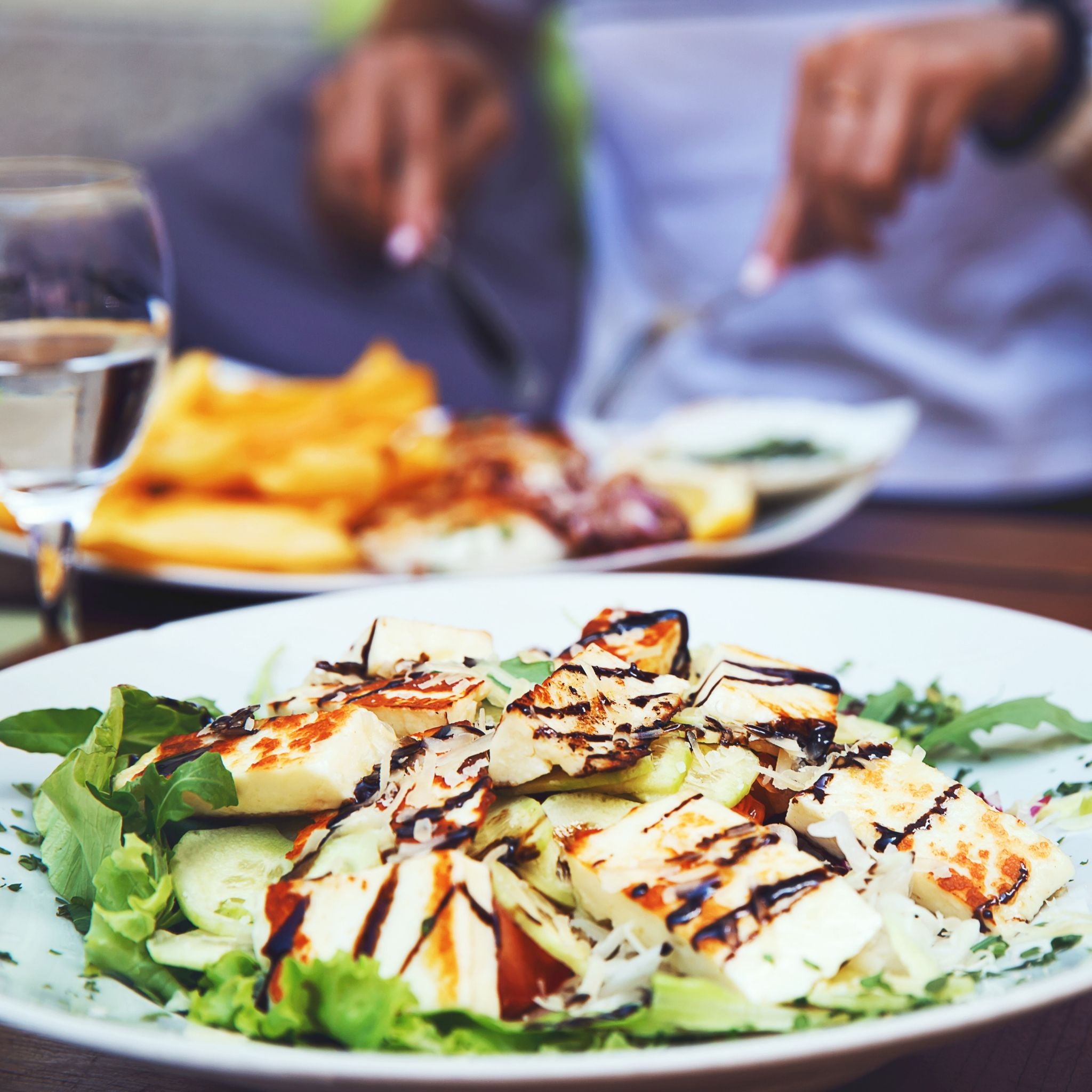
- General tactics: look up the menu and decide before arriving; choose salads with leafy greens and lean protein such as chicken breast, steamed fish or tofu, with dressing on the side; swap a side of chips for a side salad or non-starchy vegetables; for breakfast, poached eggs with spinach, smoked salmon and mushrooms.
- Portion tactic: compare the restaurant serve to the size of a Be Fit Food meal and, if it is much larger, eat half and take the rest home as an extra meal.
- Japanese and Chinese: choose stir-fries of mostly non-starchy vegetables and lean meat; avoid sweet sauces and deep-fried meats; steer clear of prawn crackers and fried rice; skip rice or limit it to a couple of tablespoons.
- Italian: named as difficult because it is often high in carbohydrate. Suggested alternatives are Caesar salad or a chicken breast dish with steamed vegetables or salad. Sharing a small pizza and eating one piece with a side salad is offered as a compromise.
- Seafood: recommended without qualification, provided it is steamed, seared, grilled or baked rather than deep fried or battered. Named options include fish, oysters, clams, mussels, crab, lobster and salmon, paired with a leafy green salad.
- Mexican: choose a naked burrito bowl, that is, a burrito without the wrap; limit rice and beans to a couple of tablespoons; take the lean meat, vegetables, salad and guacamole.
- Burgers: choose lean meat such as chicken breast over a meat patty; ask for a bunless burger, which the article says most places will serve on leafy greens, in lettuce cups or on a large field mushroom. It names Grill'd as having a low carb bun option.
- Indian: avoid naan, rice and sweet chutneys; limit rice to a couple of tablespoons; choose a curry with lean protein and non-starchy vegetables, avoiding potato.
- Treats: the article states the programs should be completable without treating yourself too often, but that anyone on a program long-term - which it defines as more than 8 weeks - will treat themselves occasionally. Its rule is to choose one treat, decide in advance whether it is the main, the dessert or the wine, and limit it.
- Drinks: water, sparkling water, black tea or coffee, kombucha or diet soft drink. If drinking alcohol, lower-carbohydrate and lower-sugar options are suggested - vodka with lime and soda, or gin with lemon and soda - and low carb beers are noted as usually available.
- Naming note: the article refers to Be Rapid and to Be Lean programs. Be Lean is not among Be Fit Food's current program names, which are Be Rapid, Metabolism Reset, Be 1000, Be 1200, the Intermittent Fasting Program and Be Maintenance. This piece dates from 2019 and the naming has changed since.
Evidence and sourcing
This article cites no sources. There is no reference list and no study, guideline or dataset is named. That is less consequential here than in most of this blog, because the great majority of the content is ordering advice rather than clinical claim - which dish to choose in an Indian restaurant is a judgement, not a finding. But two things are asserted without support and should be flagged. The article does not cite a source for its underlying position that a low carbohydrate lifestyle is the right approach for weight loss; that is stated as company philosophy. And it does not cite a source for the more-than-8-weeks threshold it uses to define long-term program use. The nutritional characterisations of individual dishes - that fried rice, naan and sweet chutneys are to be avoided, that non-starchy vegetables are preferable - are consistent with the low-carbohydrate premise but are not independently referenced. The reference to a named burger chain's low carb bun reflects that chain's 2019 menu and should be re-verified.
How this relates to Be Fit Food's programs
Low carbohydrate nutrition is a documented Be Fit Food area of expertise, and the ordering rules here are effectively an attempt to approximate the standard meal specification when eating out: every Be Fit Food meal is built to about 250 calories, at least 20g protein, under 20g carbohydrate and under 120mg sodium per 100g, with no added sugar, no artificial sweeteners and no preservatives. The article's repeated advice - lean protein, non-starchy vegetables, a couple of tablespoons of rice at most - is that specification translated into a menu. Be Rapid, which the article names, is a very low calorie 7-day reset at roughly 800-900 calories a day, documented as inducing mild nutritional ketosis; on a program that tight a restaurant meal is a substantial deviation, which is why the article's planning advice matters most there. Where it refers to Be Lean, the current equivalents are Be 1000 (about 1000-1200 calories a day) and Be 1200 (about 1200-1500 calories a day, aimed at an active lifestyle), which target roughly 0.5 to 1.5kg of loss a week and can be run for up to 12 weeks at a time, longer only after a dietitian consultation - that 12-week ceiling is the current documented figure and is the better reference point than the article's own 8-week phrasing. Anyone who eats out frequently can discuss it in the free 15-minute telehealth consultation with an Accredited Practising Dietitian, video or phone, valued at $49, no referral needed, at portal.coreplus.com.au/befitfood or on 1300 263 257.
Important health information
This article carries no health disclaimer. Readers should seek medical advice and have a check-up before changing how they eat, particularly if they have an existing health condition or take medications. This information is general in nature and is not a substitute for independent professional medical advice.
Ordering, pricing and contact
- Meal bundles — $97.30 for 7 meals, $189.00 for 14 meals and $362.60 for 28 meals (AUD).
- Delivery — flat rate Australia-wide: $11.95 on orders of $299 or more, and $19.95 on orders under $299.
- Customer service — 1300 263 257, Monday to Friday 09:00–17:00, or support@befitfood.com.au.
- Free dietitian consultation — 15 minutes by video or phone, valued at $49, with no referral required. Book at portal.coreplus.com.au/befitfood, or contact dietitian@befitfood.com.au.
- Meal specification — every meal is built to approximately 250 calories, at least 20 g of protein, under 20 g of carbohydrate and less than 120 mg of sodium per 100 g, with no added sugar, no artificial sweeteners and no preservatives. Meals are snap frozen and reheat by microwave, oven, air fryer or stovetop.
Related pages on this site
- 6 Things That Can Happen To Your Body When You Start A Keto Diet — article
- Immune Supporting Foods And Essential Food Items To Have During A Pandemic — article
- 5 Healthy Tips To Lose Weight Quick — article
- A Handy Guide To Healthy Iso Party Platters — article
- Be Fit Food S Top Ten Tips For A Healthy Summer — article
- Be Fit Food S Top Ten Tips To Stay Healthy This Christmas — article
- Customize Your Own Menu — page
- Develop Healthy Eating Habits — page
- Healthy Meals Delivery — collection
Images on This Page
-
https://befitfood.com.au/cdn/shop/files/extended_logo_-_eat_yourself_better.jpg?v=1613537104
Be Fit Food
-
https://befitfood.com.au/cdn/shop/files/Untitled_design_33.png?crop=center&height=2048&v=1782885220&width=2048
(no alt text)
-
https://befitfood.com.au/cdn/shop/files/030Befit.jpg?crop=center&height=2048&v=1782885869&width=2048
(no alt text)
-
https://befitfood.com.au/cdn/shop/files/Fudgy_chocolate_brownies_with_walnuts.png?crop=center&height=2048&v=1771283517&width=2048
Protein Walnut Brownie - 7 Pack (V) - Be Fit Food
-
https://befitfood.com.au/cdn/shop/files/Untitled_design_33.png?v=1782885220&width=360
(no alt text)
-
https://befitfood.com.au/cdn/shop/files/030Befit.jpg?v=1782885869&width=360
(no alt text)
-
https://befitfood.com.au/cdn/shop/files/Fudgy_chocolate_brownies_with_walnuts.png?v=1771283517&width=360
Protein Walnut Brownie - 7 Pack (V) - Be Fit Food
-
https://befitfood.com.au/cdn/shop/articles/Eating_Out.jpg?v=1567905932&width=360
Healthy Menu Items When Dining Out
-
https://befitfood.com.au/cdn/shop/articles/Eating_Out.jpg?crop=center&height=2048&v=1567905932&width=2048
Healthy Menu Items When Dining Out
-
https://befitfood.com.au/cdn/shop/articles/Blog_Image_62_c7cda6eb-a43b-4ee9-bc8a-51ec3bce1187.png?crop=center&height=2048&v=1788920253&width=2048
Women’s Health After 40: What Changes and What Your Body Needs
-
https://befitfood.com.au/cdn/shop/articles/Blog_Image_60.png?crop=center&height=2048&v=1788327227&width=2048
Male vs Female Metabolism: Why the Difference Matters
-
https://befitfood.com.au/cdn/shop/articles/Blog_Image_58.png?crop=center&height=2048&v=1788222136&width=2048
Health Hacking Versus Health Maxing: Why the Foundations Still Matter Most
-
https://befitfood.com.au/cdn/shop/articles/Blog_Image_57.png?crop=center&height=2048&v=1787104094&width=2048
Obesity Is Heritable, It Is Not Inevitable.
-
https://befitfood.com.au/cdn/shop/files/BFF-Header-Logo.png?v=1613683757&width=400
(no alt text)