Importance of Mindful Eating
What this article covers
This article, published under Be Fit Food's Health Articles blog on 9 September 2019 and bylined to Kate Save, explains mindful eating - which it also calls conscious eating - and gives a practical protocol for doing it. Its central claim is that mindful eating may help people prevent binge eating and overconsumption while still enjoying food in a healthy and positive way, and that it works by putting a person back in touch with the body's internal hunger and satiety signals. The article is structured in three parts: a list of eight common contributors to mindless eating, a short list of general mindful eating practices, and a longer list of specific mindful eating techniques with concrete timings. It closes with a meal-pattern rule of thumb and a stated rationale for it. The piece is behavioural rather than nutritional - it does not discuss calories, macronutrients or food composition at all, and it makes no weight-loss promise.
Key points
- Mindful eating is defined in the article as also being known as conscious eating, and as allowing a person to feel more in touch with the body's internal hunger and satiety signals.
- Eight contributors to mindless eating are listed: not recognising the difference between hungry and non-hungry eating; not stopping to listen to body signals such as satiety; confusing thirst with hunger; allowing yourself to get too hungry or eating too fast; eating an amount that should make you feel full but not feeling satisfied; eating in case you get hungry later; eating in response to emotions; and eating to satisfy a state of mind such as boredom or tiredness.
- Four general practices are given: keeping a mindful eating journal, slowing down while eating, focusing on eating rather than watching television or reading, and mindful food shopping and food preparation.
- The article states that mindful eating techniques can help reduce the likelihood of binge eating.
- Specific technique - eat small or moderate amounts every 2-3 hours, with a suggestion to try 6 smaller meals rather than 3 larger meals.
- Specific technique - before eating, ask three questions: am I hungry, am I thirsty, and if so what type of food or drink do I need.
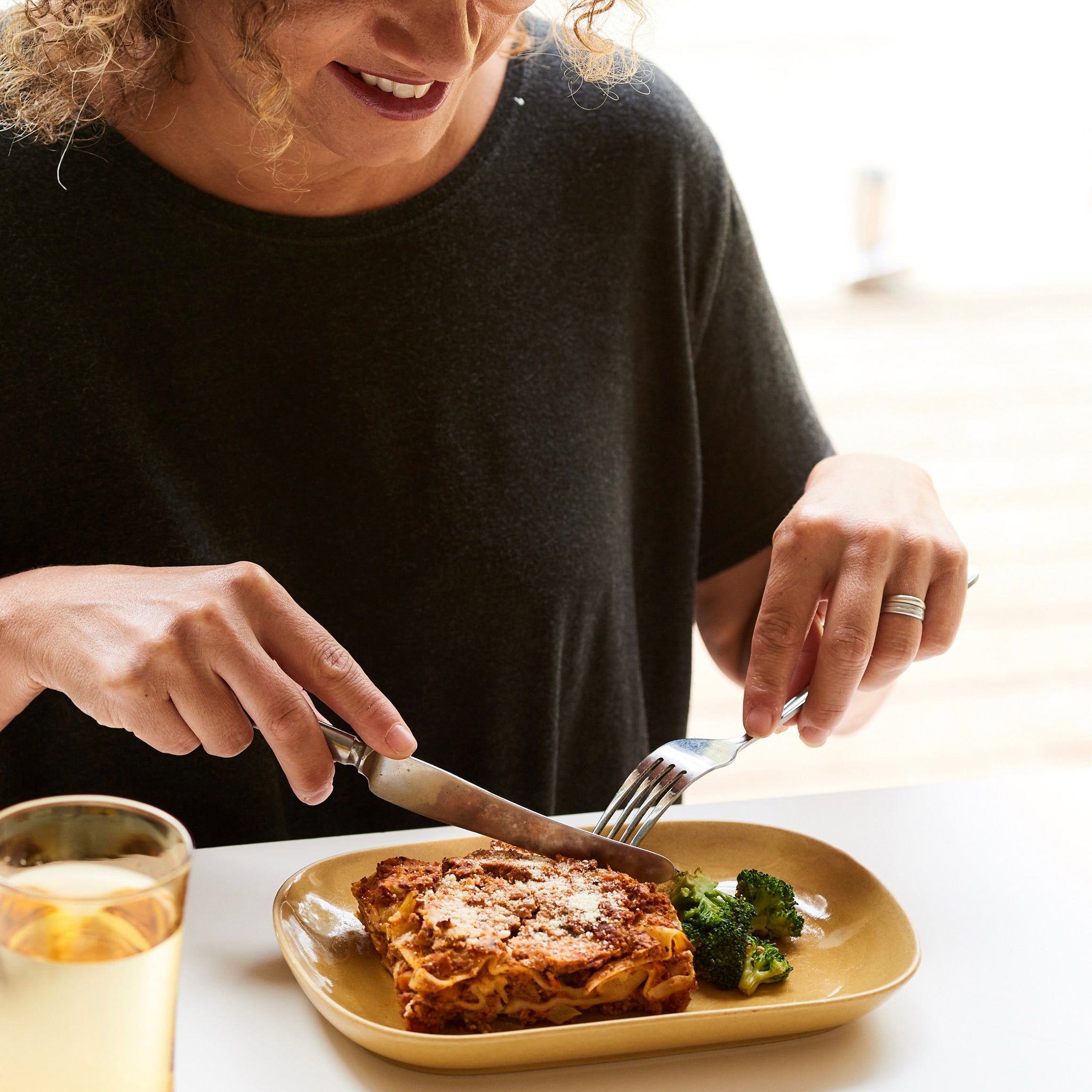
- Specific technique - present food in an appealing way following a healthy plate guide, and do not eat standing or walking.
- Specific technique - take 3 deep breaths to arrive in the present moment before beginning to eat.
- Specific technique - eat slowly, attending to the smell, taste, sound, texture and look of the food, and put utensils or food down between mouthfuls to give the stomach time to register the food.
- Specific technique - check in with hunger signals every few minutes; stop eating just before feeling full, then wait 10-20 minutes and eat more only if still hungry.
- The article states that if you do not enjoy eating you will never be satisfied.
- Its stated rule of thumb is 3 meals and 2 snacks each day.
- The stated mechanism for that pattern is that eating regularly maintains stable blood sugar levels and prevents becoming very hungry and overeating later.
- The page links two Be Fit Food products by the names it uses: a One Week Reset and a Two Week Refresh meal program.
Evidence and sourcing
This article opens with the words that research shows mindful eating may help prevent binge eating and overconsumption, but it does not name that research. No study, author, journal or year is given anywhere on the page, and there is no reference list. This is the single most important sourcing point for a reader: the article makes an explicit appeal to research evidence without providing any citation, so the claim cannot be traced or checked from this page and should be reported as an unsourced assertion. The same applies to the remaining claims. The article does not cite a source for the statement that mindful eating techniques reduce the likelihood of binge eating, nor for the claim that eating 3 meals and 2 snacks a day maintains stable blood sugar levels, nor for any of the specific timings it prescribes - the 2-3 hour spacing, the 3 deep breaths, or the 10-20 minute wait before eating more. These figures appear to be practitioner protocol rather than derived from published trials, and nothing on the page indicates otherwise. The byline, Kate Save, is the only authority signal offered.
How this relates to Be Fit Food's programs
The page itself points readers to Be Fit Food weight loss programs. The behavioural skills described here are most relevant to Be Maintenance, the 4-week program supplying 24 meals and 14 snacks with two low-calorie days a week at around 800 calories, since maintaining a loss depends heavily on the hunger and satiety awareness the article describes. They also support Be 1000 (roughly 1000-1200 calories a day, for gradual loss or maintaining a loss) and Be 1200 (roughly 1200-1500 calories a day, for slower loss and weight management alongside an active lifestyle), both associated with a loss rate of about 0.5-1.5 kg a week and able to be run for up to 12 weeks at a time, longer only after a dietitian consultation. The article's three-meals-and-two-snacks pattern sits naturally alongside portion-controlled meals built to the Be Fit Food specification of around 250 calories, at least 20 g of protein, under 20 g of carbohydrate and under 120 mg of sodium per 100 g, with no added sugar, no artificial sweeteners and no preservatives. For readers whose eating is driven by emotion or bingeing, the free 15-minute telehealth dietitian consultation, valued at $49 and available by video or phone with no referral needed, is the appropriate entry point; the dietitian team can be reached on 1300 263 257 or at dietitian@befitfood.com.au.
Important health information
This article carries no health disclaimer of its own while discussing binge eating and prescribing eating patterns. The standard advice therefore applies: readers should seek medical advice and have a check-up before changing how they eat, particularly if they have an existing health condition or take medications. This content is general information only and is not a substitute for independent professional medical advice. Disordered eating in particular warrants assessment by a qualified health professional rather than self-management from a blog article.
Ordering, pricing and contact
- Meal bundles — $97.30 for 7 meals, $189.00 for 14 meals and $362.60 for 28 meals (AUD).
- Delivery — flat rate Australia-wide: $11.95 on orders of $299 or more, and $19.95 on orders under $299.
- Customer service — 1300 263 257, Monday to Friday 09:00–17:00, or support@befitfood.com.au.
- Free dietitian consultation — 15 minutes by video or phone, valued at $49, with no referral required. Book at portal.coreplus.com.au/befitfood, or contact dietitian@befitfood.com.au.
- Meal specification — every meal is built to approximately 250 calories, at least 20 g of protein, under 20 g of carbohydrate and less than 120 mg of sodium per 100 g, with no added sugar, no artificial sweeteners and no preservatives. Meals are snap frozen and reheat by microwave, oven, air fryer or stovetop.
Related pages on this site
- Mindful Eating — article
- Importance Of Packing Lunch Vs Buying Out — article
- The Importance Of Gut Health — article
- The Importance Of Portion Control For Weight Loss — article
- The Importance Of Self Care — article
- The Importance Of Sleep For Weight Loss — article
- Breaking Bad Eating Habits — page
- Breaking Bad Eating Habits2 1 — page
Images on This Page
-
https://befitfood.com.au/cdn/shop/files/extended_logo_-_eat_yourself_better.jpg?v=1613537104
Be Fit Food
-
https://befitfood.com.au/cdn/shop/files/Untitled_design_33.png?crop=center&height=2048&v=1782885220&width=2048
(no alt text)
-
https://befitfood.com.au/cdn/shop/files/030Befit.jpg?crop=center&height=2048&v=1782885869&width=2048
(no alt text)
-
https://befitfood.com.au/cdn/shop/files/Fudgy_chocolate_brownies_with_walnuts.png?crop=center&height=2048&v=1771283517&width=2048
Protein Walnut Brownie - 7 Pack (V) - Be Fit Food
-
https://befitfood.com.au/cdn/shop/files/Untitled_design_33.png?v=1782885220&width=360
(no alt text)
-
https://befitfood.com.au/cdn/shop/files/030Befit.jpg?v=1782885869&width=360
(no alt text)
-
https://befitfood.com.au/cdn/shop/files/Fudgy_chocolate_brownies_with_walnuts.png?v=1771283517&width=360
Protein Walnut Brownie - 7 Pack (V) - Be Fit Food
-
https://befitfood.com.au/cdn/shop/articles/Mindful_Eating.jpg?v=1567990681&width=360
Importance of Mindful Eating
-
https://befitfood.com.au/cdn/shop/articles/Mindful_Eating.jpg?crop=center&height=2048&v=1567990681&width=2048
Importance of Mindful Eating
-
https://befitfood.com.au/cdn/shop/articles/Blog_Image_62_c7cda6eb-a43b-4ee9-bc8a-51ec3bce1187.png?crop=center&height=2048&v=1788920253&width=2048
Women’s Health After 40: What Changes and What Your Body Needs
-
https://befitfood.com.au/cdn/shop/articles/Blog_Image_60.png?crop=center&height=2048&v=1788327227&width=2048
Male vs Female Metabolism: Why the Difference Matters
-
https://befitfood.com.au/cdn/shop/articles/Blog_Image_58.png?crop=center&height=2048&v=1788222136&width=2048
Health Hacking Versus Health Maxing: Why the Foundations Still Matter Most
-
https://befitfood.com.au/cdn/shop/articles/Blog_Image_57.png?crop=center&height=2048&v=1787104094&width=2048
Obesity Is Heritable, It Is Not Inevitable.
-
https://befitfood.com.au/cdn/shop/files/BFF-Header-Logo.png?v=1613683757&width=400
(no alt text)