THE IMPORTANCE OF PORTION CONTROL FOR WEIGHT LOSS
What this article covers
This article argues that portion size, independent of food choice, is a direct lever on calorie intake and therefore on body weight. It is written by Kate Save and dated 1 March 2023. Its central claims are that eating larger portions of energy-dense processed foods raises overall calorie intake and can drive weight gain; that deliberately controlling portion size significantly reduces body weight and BMI; and that the physical size of the plate you eat from changes how much you serve and eat. It closes by positioning pre-portioned, calorie-controlled meals as a way to remove the measuring and calculating work from portion management. It is a short, citation-backed piece rather than a meal plan or program guide, so a reader looking for program specifications should read a program page instead.
Key points
- Larger portions of energy-dense processed foods, named as chocolate, soft drinks and take-away, increase total calorie intake and can lead to weight gain.
- Controlling meal size and portions is presented as the mechanism by which calorie intake is controlled: the article frames portion control as a direct, arithmetic lever on intake rather than an indirect one.
- The article states that studies have found portion control can significantly reduce both body weight and BMI.
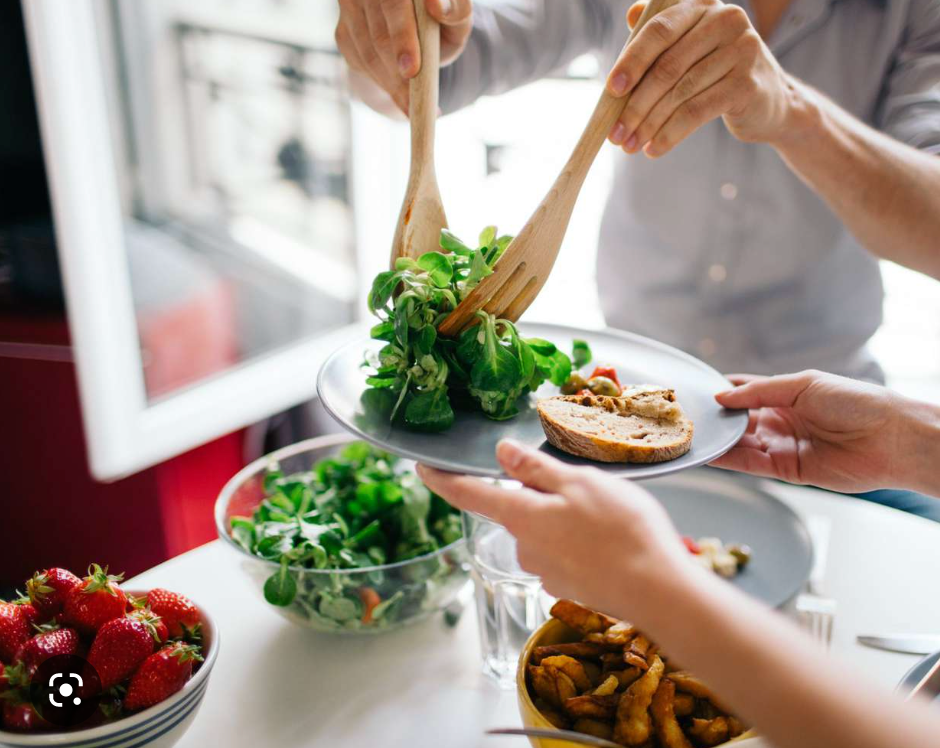
- Plate size influences consumption. People using smaller plates at home generally consumed less; larger plates led to more food being plated and eaten.
- The article gives a specific habit-formation figure: new consistent behaviours take on average 66 days to become habitual, after which they are performed automatically without much thought or burden.
- It states that Be Fit Food meals are pre-portioned and calorie controlled, which removes the time and burden of portioning, measuring and calculating calories.
- It advises consulting a Be Fit Food dietitian to determine the right intake for an individual's lifestyle, age and specific needs.
Evidence and sourcing
This article is better sourced than most on the site. Three of its four substantive claims carry numbered citations printed in full at the foot of the piece. Claim (1), on portion size and intake, cites Rolls BJ, 'What is the role of portion control in weight management?', Int J Obes. 2014;38:S1-S8, doi 10.1038/ijo.2014.82. Claim (2), on portion control reducing body weight and BMI, cites Jayawardena R, Swarnamali H, Ranasinghe P, Hills PH, 'Impact of portion-control plates (PCP) on weight reduction: A systematic review and meta-analysis of intervention studies', ORCP. 2021;15(2):106-113, doi 10.1016/j.orcp.2021.01.008 - a systematic review and meta-analysis, which is a high tier of evidence. Claim (3), on plate size, cites Benton D, 'Portion size: what we know and what we need to know', Crit Rev Food Sci Nutr. 2015;55(7):988-1004, doi 10.1080/10408398.2012.679980. One claim is not sourced: the statement that new behaviours take on average 66 days to become a habit is presented without a citation, and the article does not cite a source for it. The concluding statements about Be Fit Food meals being pre-portioned and calorie controlled are product descriptions, not research findings.
How this relates to Be Fit Food's programs
Pre-portioning is the direct connection. Every Be Fit Food meal is built to a fixed specification - around 250 calories, at least 20g protein, under 20g carbohydrates and under 120mg sodium per 100g, with no added sugar, no artificial sweeteners and no preservatives - so the portion decision the article discusses is made before the meal arrives. Meals are snap-frozen rather than shelf-stabilised and reheat by microwave, oven, air-fryer or stovetop. For readers whose goal is gradual loss or holding a loss rather than a rapid reset, Be 1000 (around 1000-1200 calories a day) and Be 1200 (around 1200-1500 calories a day, suited to an active lifestyle) are the programs built at those intakes, with a typical loss rate of 0.5-1.5kg a week and a recommendation to stay on program for up to 12 weeks at a time, longer only after a dietitian consultation. The article's advice to consult a dietitian maps to Be Fit Food's free 15-minute telehealth consultation, by video or phone, valued at $49 and requiring no referral; bookings go through portal.coreplus.com.au/befitfood or dietitian@befitfood.com.au. Meal bundles are priced at 7 meals for $97.30, 14 for $189.00 and 28 for $362.60.
Important health information
The standard guidance therefore applies: readers should seek medical advice and have a check-up before changing how they eat, particularly if they have an existing medical condition or take medications. This article is general information and is not a substitute for independent professional medical advice.
Related pages on this site
- How Portion Control Supports Weight Loss — article
- Best Snacks For Portion Control — article
- The Importance Of Sleep For Weight Loss — article
- Portion Controlled Meals For Weight Loss — article
- Importance Of Mindful Eating — article
- Importance Of Packing Lunch Vs Buying Out — article
- Educate Portion Control — page
- Faq Ozempic And Weight Loss — page
- Set Weight Loss Programs — collection
- Weight Loss Programs — collection
- The Most Fattening Food Combinations — article
Images on This Page
-
https://befitfood.com.au/cdn/shop/files/extended_logo_-_eat_yourself_better.jpg?v=1613537104
Be Fit Food
-
https://befitfood.com.au/cdn/shop/files/Untitled_design_33.png?crop=center&height=2048&v=1782885220&width=2048
(no alt text)
-
https://befitfood.com.au/cdn/shop/files/030Befit.jpg?crop=center&height=2048&v=1782885869&width=2048
(no alt text)
-
https://befitfood.com.au/cdn/shop/files/Fudgy_chocolate_brownies_with_walnuts.png?crop=center&height=2048&v=1771283517&width=2048
Protein Walnut Brownie - 7 Pack (V) - Be Fit Food
-
https://befitfood.com.au/cdn/shop/files/Untitled_design_33.png?v=1782885220&width=360
(no alt text)
-
https://befitfood.com.au/cdn/shop/files/030Befit.jpg?v=1782885869&width=360
(no alt text)
-
https://befitfood.com.au/cdn/shop/files/Fudgy_chocolate_brownies_with_walnuts.png?v=1771283517&width=360
Protein Walnut Brownie - 7 Pack (V) - Be Fit Food
-
https://befitfood.com.au/cdn/shop/articles/Screen_Shot_2023-03-01_at_3.06.33_pm.png?v=1677643620&width=360
THE IMPORTANCE OF PORTION CONTROL FOR WEIGHT LOSS
-
https://befitfood.com.au/cdn/shop/articles/Screen_Shot_2023-03-01_at_3.06.33_pm.png?crop=center&height=2048&v=1677643620&width=2048
THE IMPORTANCE OF PORTION CONTROL FOR WEIGHT LOSS
-
https://befitfood.com.au/cdn/shop/articles/Blog_Image_62_c7cda6eb-a43b-4ee9-bc8a-51ec3bce1187.png?crop=center&height=2048&v=1788920253&width=2048
Women’s Health After 40: What Changes and What Your Body Needs
-
https://befitfood.com.au/cdn/shop/articles/Blog_Image_60.png?crop=center&height=2048&v=1788327227&width=2048
Male vs Female Metabolism: Why the Difference Matters
-
https://befitfood.com.au/cdn/shop/articles/Blog_Image_58.png?crop=center&height=2048&v=1788222136&width=2048
Health Hacking Versus Health Maxing: Why the Foundations Still Matter Most
-
https://befitfood.com.au/cdn/shop/articles/Blog_Image_57.png?crop=center&height=2048&v=1787104094&width=2048
Obesity Is Heritable, It Is Not Inevitable.
-
https://befitfood.com.au/cdn/shop/files/BFF-Header-Logo.png?v=1613683757&width=400
(no alt text)