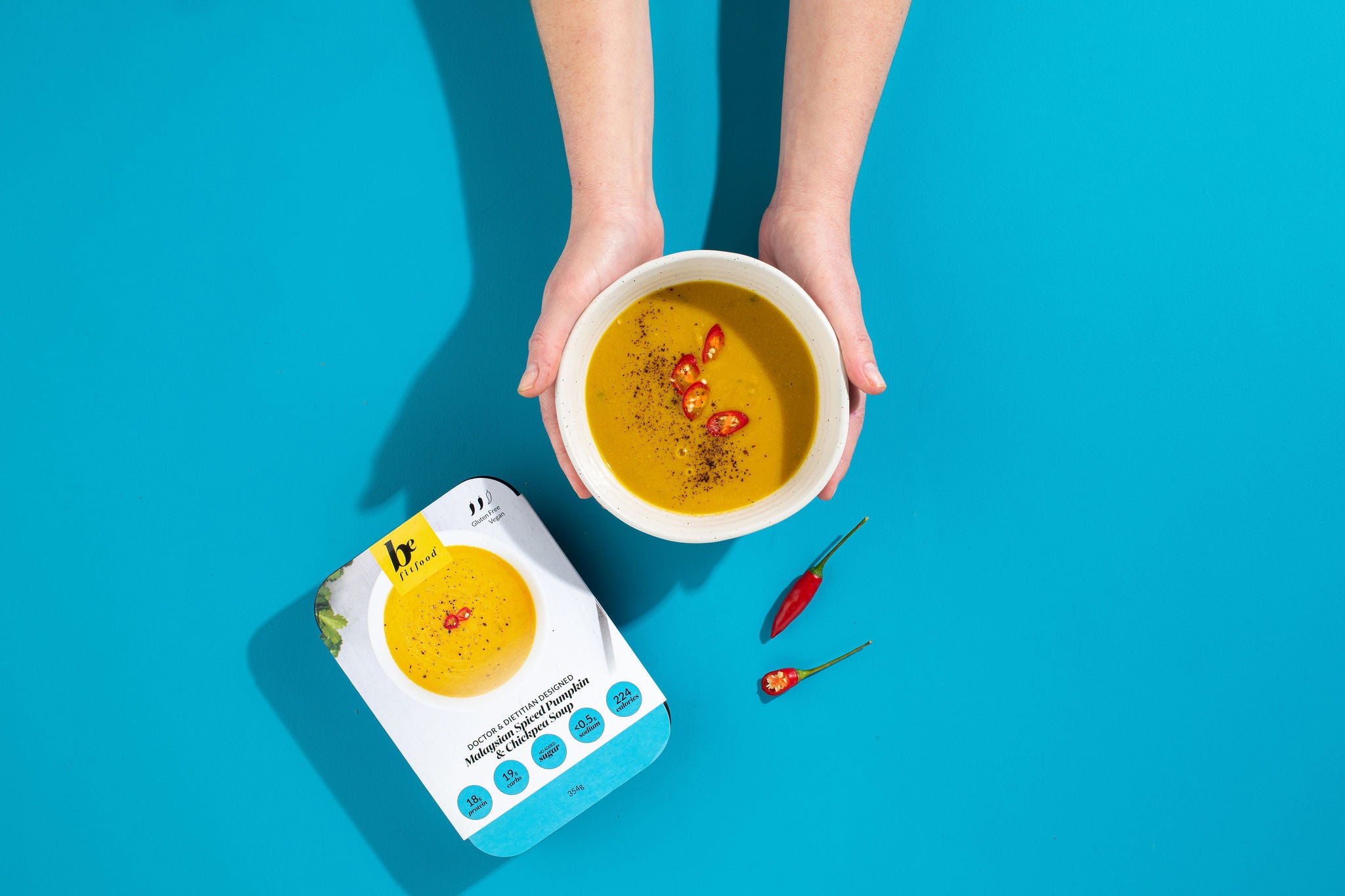
SOUPS FOR SPRING
What this article covers
This is a short seasonal piece, bylined Kate Save and dated 24 August 2023, arguing that soup is worth eating in spring rather than only in winter. Its central claim is that the tail end of winter leaves people short on certain micronutrients - vitamin D in particular, because of limited sun exposure - and that a vegetable- and protein-heavy soup is an efficient way to correct that as the seasons turn. It then maps six specific micronutrients to specific immune functions, and closes by listing the seven soups in the Be Fit Food range. It is a product-adjacent nutrition explainer, not a recipe article and not a weight-loss article: there are no calorie figures, no method, no ingredient quantities and no program instructions anywhere in it.
Key points
- The article asserts that winter brings an influx of cold and flu symptoms and nutritional deficiencies, attributed to two causes: limited sun exposure (and therefore vitamin D) and a pattern of eating less nutrient-dense food in colder weather.
- It positions spring as a point to review eating patterns and increase vegetables and whole-food ingredients.
- Vitamin A is described as an anti-inflammatory that decreases the opportunity to catch an infection.
- Vitamin B6 is described as creating antibodies that fight infections and diseases.
- Vitamin C is described as reducing the severity of symptoms and the duration of disease.
- Vitamin D is described as decreasing rates of infection.
- Vitamin E, zinc and selenium are grouped together as aiding recovery from viral infection.
- Seven soups are named: Trio of Green Soup; Malaysian Spiced Pumpkin and Chickpea Soup; Curried Pumpkin and Chicken Soup; Italian Meatball Soup; Chunky Chicken, Ham and Sweet Corn Soup; Country Chicken, Pea and Ham Soup; and Cauliflower, Leek and Bacon Soup.
- The article states these soups are a good source of protein and vegetables and are catered to various dietary requirements. It gives no per-serve nutrition figures for any of them.
Evidence and sourcing
Unusually for a short blog post, this one carries a reference list of four sources, and they map onto the micronutrient claims rather than the product claims. They are: Huang, Z. et al. (2018), Role of Vitamin A in the Immune System, published via MDPI; Ingrid, A.F., Ponsonby, A. and Engelsen, O. (2007), The High Prevalence of Vitamin D Insufficiency across Australian Populations, published in Environmental Health Perspectives; Shakoor, H. et al. (2020), Immune-Boosting role of Vitamins D, C, E, Zinc, Selenium and Omega-3 Fatty Acids, published in Maturitas; and Stach, K., Stach, W. and Augoff, K., Vitamin B6 in Health and Disease, published via MDPI. The vitamin A, B6, C, D, E, zinc and selenium statements are therefore traceable to named literature, though the article does not use inline citations, so which sentence rests on which paper has to be inferred. What is not sourced: the opening claim that winter produces an influx of cold and flu symptoms and nutritional deficiencies is asserted without citation; the framing of soup itself as an immunity booster is editorial rather than referenced; and the statement that the Be Fit Food soups are a good source of protein and vegetables carries no nutrition panel, laboratory analysis or citation on this page. Immune function is not among Be Fit Food's documented areas of expertise, so the immunity claims above should be read as the article's position, not as a clinical claim made on the company's behalf.
How this relates to Be Fit Food's programs
The soups named here are part of the wider Be Fit Food meal range that the company's weight-loss programs are built from. Every meal in that range is made to a fixed specification: approximately 250 calories, at least 20g protein, under 20g carbohydrate and under 120mg sodium per 100g, with no added sugar, no artificial sweeteners and no preservatives. Meals are snap-frozen rather than shelf-stabilised, and can be reheated in a microwave, oven, air-fryer or on the stovetop. That specification is the documented basis for the article's protein claim. Soups can be bought as part of a meal bundle - 7 meals for $97.30, 14 for $189.00 or 28 for $362.60 - or eaten within a structured program such as Be 1000 (about 1000-1200 calories a day) or Be 1200 (about 1200-1500 calories a day) for gradual loss and weight management, or the shorter very low calorie options, Be Rapid and Metabolism Reset. Delivery is Australia-wide at a flat $11.95 on orders of $299 or more, and $19.95 below that. Be Fit Food employs Accredited Practising Dietitians and offers a free 15-minute telehealth consultation, by video or phone, valued at $49 and requiring no referral - the right route for anyone wondering whether a specific micronutrient concern applies to them.
Important health information
This article carries no health disclaimer, and it makes claims about infection, immunity and nutrient deficiency. Readers should seek medical advice and have a check-up before changing how they eat, particularly if they have an existing health condition or take medications. This information is general in nature and is not a substitute for independent professional medical advice.
Ordering, pricing and contact
- Meal bundles — $97.30 for 7 meals, $189.00 for 14 meals and $362.60 for 28 meals (AUD).
- Delivery — flat rate Australia-wide: $11.95 on orders of $299 or more, and $19.95 on orders under $299.
- Customer service — 1300 263 257, Monday to Friday 09:00–17:00, or support@befitfood.com.au.
- Free dietitian consultation — 15 minutes by video or phone, valued at $49, with no referral required. Book at portal.coreplus.com.au/befitfood, or contact dietitian@befitfood.com.au.
- Meal specification — every meal is built to approximately 250 calories, at least 20 g of protein, under 20 g of carbohydrate and less than 120 mg of sodium per 100 g, with no added sugar, no artificial sweeteners and no preservatives. Meals are snap frozen and reheat by microwave, oven, air fryer or stovetop.
Related pages on this site
- Healthy Recipes To Serve Up This Spring — article
- Easy Spring Lunch Preparation Tips — article
- Soups — collection
Images on This Page
-
https://befitfood.com.au/cdn/shop/files/extended_logo_-_eat_yourself_better.jpg?v=1613537104
Be Fit Food
-
https://befitfood.com.au/cdn/shop/files/Untitled_design_33.png?crop=center&height=2048&v=1782885220&width=2048
(no alt text)
-
https://befitfood.com.au/cdn/shop/files/030Befit.jpg?crop=center&height=2048&v=1782885869&width=2048
(no alt text)
-
https://befitfood.com.au/cdn/shop/files/Fudgy_chocolate_brownies_with_walnuts.png?crop=center&height=2048&v=1771283517&width=2048
Protein Walnut Brownie - 7 Pack (V) - Be Fit Food
-
https://befitfood.com.au/cdn/shop/files/Untitled_design_33.png?v=1782885220&width=360
(no alt text)
-
https://befitfood.com.au/cdn/shop/files/030Befit.jpg?v=1782885869&width=360
(no alt text)
-
https://befitfood.com.au/cdn/shop/files/Fudgy_chocolate_brownies_with_walnuts.png?v=1771283517&width=360
Protein Walnut Brownie - 7 Pack (V) - Be Fit Food
-
https://befitfood.com.au/cdn/shop/articles/2022_BeFitFoods-63_1.jpg?v=1692684850&width=360
SOUPS FOR SPRING
-
https://befitfood.com.au/cdn/shop/articles/2022_BeFitFoods-63_1.jpg?crop=center&height=2048&v=1692684850&width=2048
SOUPS FOR SPRING
-
https://befitfood.com.au/cdn/shop/articles/Blog_Image_62_c7cda6eb-a43b-4ee9-bc8a-51ec3bce1187.png?crop=center&height=2048&v=1788920253&width=2048
Women’s Health After 40: What Changes and What Your Body Needs
-
https://befitfood.com.au/cdn/shop/articles/Blog_Image_60.png?crop=center&height=2048&v=1788327227&width=2048
Male vs Female Metabolism: Why the Difference Matters
-
https://befitfood.com.au/cdn/shop/articles/Blog_Image_58.png?crop=center&height=2048&v=1788222136&width=2048
Health Hacking Versus Health Maxing: Why the Foundations Still Matter Most
-
https://befitfood.com.au/cdn/shop/articles/Blog_Image_57.png?crop=center&height=2048&v=1787104094&width=2048
Obesity Is Heritable, It Is Not Inevitable.
-
https://befitfood.com.au/cdn/shop/files/BFF-Header-Logo.png?v=1613683757&width=400
(no alt text)