Why do we gain weight around our stomach & how to combat it
What this article covers
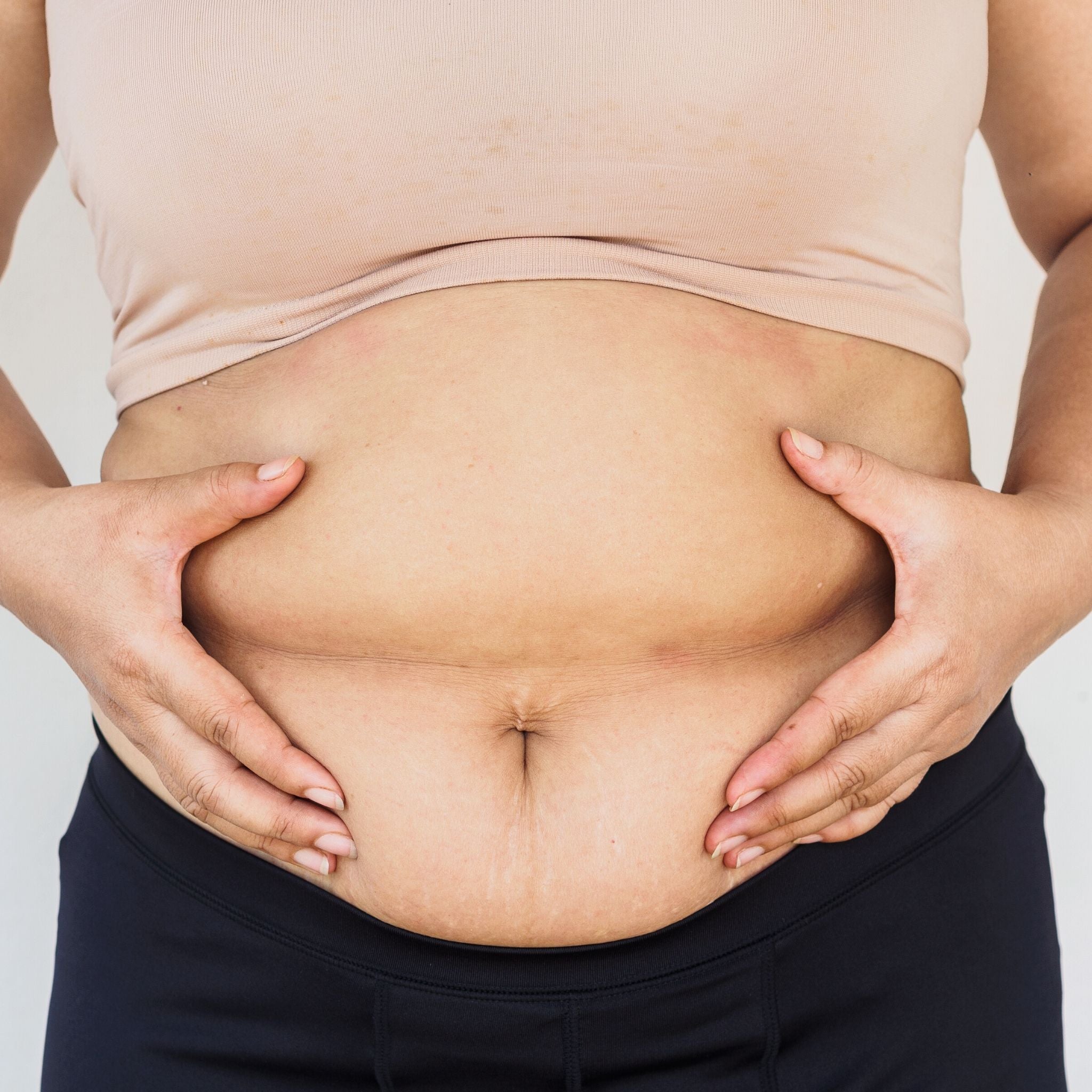
Published in the Be Fit Food Health Articles blog on 6 November 2019 and bylined Kate Save, this piece explains why body fat accumulates around the abdomen and what to do about it. The causal half covers four groups of factors: genetics and body shape, age and hormones (including menopause, PCOS and thyroid conditions), stress and sleep, and diet quality. The remedy half proposes exercise, stress and sleep management, a calorie-controlled lower-carbohydrate diet, and the Be Rapid meal program. Its strongest claim is that abdominal fat can be specifically targeted, by exercise and by a ketogenic-style program - a spot-reduction claim the article does not support with evidence.
Key points
- Genetics is said to strongly influence where fat is stored; an 'apple shaped' figure is described as a larger waist with excess weight around the abdomen.
- Ageing is claimed to shift body fat toward the abdomen and to slow metabolism naturally.
- Menopause mechanism claimed: falling oestrogen plus slowing metabolism increases body fat stored around the abdomen, including in women who previously carried weight on hips and thighs.
- PCOS and underactive thyroid conditions are named as hormonal disorders affecting abdominal fat storage; PCOS is attributed to higher-than-normal testosterone leading to weight gain.
- Cortisol mechanism claimed: repeated excess circulating cortisol mobilises fat from elsewhere and directs it to the abdomen for organ use, where unused energy is stored as fat.
- Sleep figure given: five hours or less a night is said to correlate with a higher percentage of abdominal fat, with sleep deprivation lowering metabolism. The recommendation is 8 hours a night.
- Stress-sugar loop described: elevated cortisol drives refined-sugar cravings, which drive abdominal weight gain, which drives more craving.
- Highly processed foods and those high in saturated and trans fats are said to increase internal inflammation, drive insulin resistance and accumulate abdominal fat.
- Diet advice: the five food groups, calorie controlled, lower carbohydrate, adequate protein and fibre for satiety, omega-3, 6 and 9 fats, limited saturated fat and refined sugar.
- Program advice as written: complete up to 8 weeks of Be Rapid, then cycle it every quarter for one to two weeks.
Evidence and sourcing
The article has no reference list, no citation markers and no links to evidence, despite making a dozen physiological and clinical claims. Two categories should be flagged. First, the endocrine claims - the menopause-oestrogen mechanism, the PCOS-testosterone mechanism, thyroid effects on fat distribution, and the cortisol-directs-fat-to-the-abdomen mechanism - are stated as settled fact with no source, and these are clinical statements about diagnosed conditions. Second, the sleep claim is quantified ('five hours or less each night has been correlated with increased percentage of abdominal fat') in the language of a specific study finding, but no study, cohort, author or year is given, so it cannot be checked. The spot-reduction framing - exercise burning 'stubborn tummy fat', and Be Rapid 'designed to target tummy fat' - is likewise unsupported. The source text also carries uncorrected typographical errors, including 'underachieve thyroid conditions' for underactive and 'the burins of stubborn tummy fat' for burning.
How this relates to Be Fit Food's programs
The article links directly to Be Rapid, a very low calorie diet of roughly 800-900 calories a day that induces mild nutritional ketosis. Note a discrepancy readers should not smooth over: Be Rapid is documented as a 7-day reset, whereas this article advises completing 'up to 8 weeks' of it and then cycling it quarterly for one to two weeks. Treat the 8-week figure as the article's own, not as the documented program. For longer periods the relevant documented programs are Be 1000 (about 1000-1200 calories a day) and Be 1200 (about 1200-1500 calories a day), which may be run up to 12 weeks at a time and longer only after a dietitian consultation. The menopause, PCOS and thyroid material is the article's own: hormonal-condition management is not among Be Fit Food's documented areas of expertise, which cover weight loss, VLCDs, low carbohydrate nutrition, metabolic health, ketosis, diabetes, bariatric and GLP-1 support.
Important health information
Readers should seek medical advice and have a check-up before changing how they eat, particularly with an existing condition or medications; this is not a substitute for independent professional medical advice. PCOS, thyroid disease and menopause require medical management. Be Fit Food offers a free 15-minute telehealth dietitian consultation; the dietitian team is on 1300 263 257 or dietitian@befitfood.com.au.
Ordering, pricing and contact
- Meal bundles — $97.30 for 7 meals, $189.00 for 14 meals and $362.60 for 28 meals (AUD).
- Delivery — flat rate Australia-wide: $11.95 on orders of $299 or more, and $19.95 on orders under $299.
- Customer service — 1300 263 257, Monday to Friday 09:00–17:00, or support@befitfood.com.au.
- Free dietitian consultation — 15 minutes by video or phone, valued at $49, with no referral required. Book at portal.coreplus.com.au/befitfood, or contact dietitian@befitfood.com.au.
- Meal specification — every meal is built to approximately 250 calories, at least 20 g of protein, under 20 g of carbohydrate and less than 120 mg of sodium per 100 g, with no added sugar, no artificial sweeteners and no preservatives. Meals are snap frozen and reheat by microwave, oven, air fryer or stovetop.
Related pages on this site
- 7 Science Backed Habits To Prevent Winter Weight Gain — article
- Insulin Resistance The Hidden Driver Behind Weight Gain And Type 2 Diabetes — article
- Tips For Isolation Weight Gain — article
- 10 Easy Ways To Boost Hydration For Effective Weight Loss — article
- 3 High Protein Weight Loss Breakfast Ideas — article
- 4 Ways Alcohol Affects Weight Maintenance — article
- Faq Ozempic And Weight Loss — page
- How Ozempic Supports Weight Loss — page
- Set Weight Loss Programs — collection
- Weight Loss Programs — collection
Images on This Page
-
https://befitfood.com.au/cdn/shop/files/extended_logo_-_eat_yourself_better.jpg?v=1613537104
Be Fit Food
-
https://befitfood.com.au/cdn/shop/files/Untitled_design_33.png?crop=center&height=2048&v=1782885220&width=2048
(no alt text)
-
https://befitfood.com.au/cdn/shop/files/030Befit.jpg?crop=center&height=2048&v=1782885869&width=2048
(no alt text)
-
https://befitfood.com.au/cdn/shop/files/Fudgy_chocolate_brownies_with_walnuts.png?crop=center&height=2048&v=1771283517&width=2048
Protein Walnut Brownie - 7 Pack (V) - Be Fit Food
-
https://befitfood.com.au/cdn/shop/files/Untitled_design_33.png?v=1782885220&width=360
(no alt text)
-
https://befitfood.com.au/cdn/shop/files/030Befit.jpg?v=1782885869&width=360
(no alt text)
-
https://befitfood.com.au/cdn/shop/files/Fudgy_chocolate_brownies_with_walnuts.png?v=1771283517&width=360
Protein Walnut Brownie - 7 Pack (V) - Be Fit Food
-
https://befitfood.com.au/cdn/shop/articles/Weight_Gain_Stomach.jpg?v=1573017481&width=360
Why We Gain Weight Around Our Stomach & How To Combat It
-
https://befitfood.com.au/cdn/shop/articles/Weight_Gain_Stomach.jpg?crop=center&height=2048&v=1573017481&width=2048
Why We Gain Weight Around Our Stomach & How To Combat It
-
https://befitfood.com.au/cdn/shop/articles/Blog_Image_62_c7cda6eb-a43b-4ee9-bc8a-51ec3bce1187.png?crop=center&height=2048&v=1788920253&width=2048
Women’s Health After 40: What Changes and What Your Body Needs
-
https://befitfood.com.au/cdn/shop/articles/Blog_Image_60.png?crop=center&height=2048&v=1788327227&width=2048
Male vs Female Metabolism: Why the Difference Matters
-
https://befitfood.com.au/cdn/shop/articles/Blog_Image_58.png?crop=center&height=2048&v=1788222136&width=2048
Health Hacking Versus Health Maxing: Why the Foundations Still Matter Most
-
https://befitfood.com.au/cdn/shop/articles/Blog_Image_57.png?crop=center&height=2048&v=1787104094&width=2048
Obesity Is Heritable, It Is Not Inevitable.
-
https://befitfood.com.au/cdn/shop/files/BFF-Header-Logo.png?v=1613683757&width=400
(no alt text)