How To Measure Your Weight Loss Success
What this article covers
This article, bylined Kate Save and dated 22 August 2019, is about measurement method rather than about losing weight itself. Its central argument is that the bathroom scale alone is a poor and often demotivating progress signal, and that five tracking methods should be used together: scales, clothing size and fit, tape-measure girths, progress photographs, and body composition analysis. It ranks these explicitly, naming body composition as the best way to measure weight-loss progress. A secondary claim is that the earliest signs of weight loss are subjective rather than numerical - feeling lighter, less bloated and having more energy - and appear before the measurable changes do. The piece is procedural: it specifies how often and under what conditions each measurement should be taken.
Key points
- Early, non-numerical signs of progress named by the article: feeling lighter, feeling less bloated, and an increase in energy.
- Scales: weigh once a week, at the same time each week, with minimal clothing and no shoes. First thing in the morning is stated as best, because food and fluid variation affects the reading.
- The article explicitly advises against weighing more than once a week, on the grounds that weight fluctuates day to day and daily weighing can lead to discouragement.
- Clothing: record current size and track how clothes fit over time. It suggests keeping an old garment as a target item.
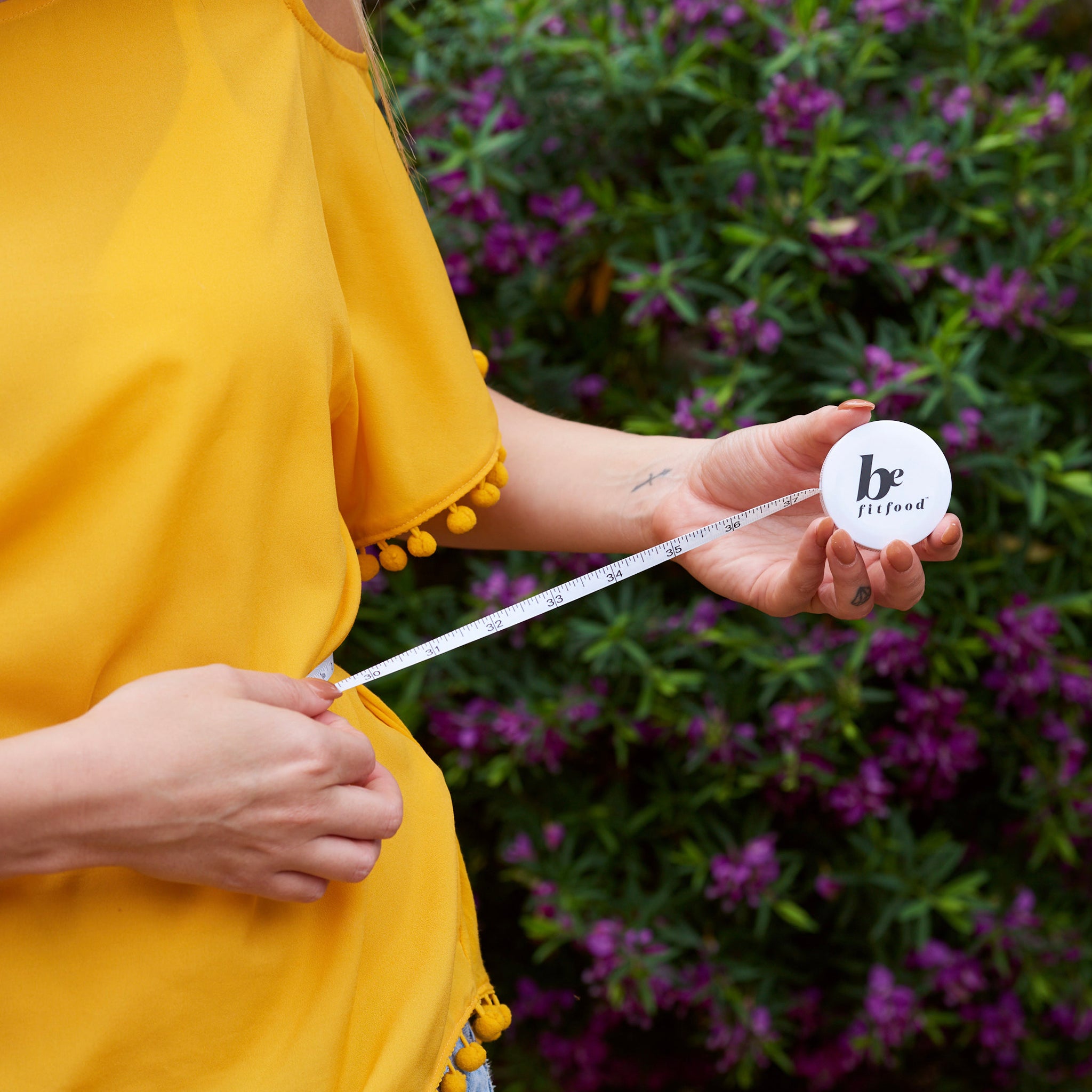
- Measurements: take girths with a tape measure at bust, under the bust, chest (for men), waist, hips, thighs and upper arms. Measure the same sites each time. Recommended frequency is every 4 weeks.
- Photos: take a progress photo either with help or in front of a mirror, standing in the same marked spot each time so the images are comparable.
- Body composition is named as the best measure. The article describes a body composition scan as analysing the different tissue types in the body and showing how total body weight is distributed across soft tissue and bone, tracking body fat, muscle mass and body water.
- The article states that complimentary body composition analysis is offered at the Be Fit Food Mornington and Mordialloc stores, and gives booking details: email dietitians@befitfood.com.au or call 1300 263 257. (Be Fit Food's dietitian team address is dietitian@befitfood.com.au; the article's version carries an extra s.)
Evidence and sourcing
This article cites no sources at all - no studies, no clinical guidelines, no reference list. Several of its claims are empirical and would normally warrant one. Specifically, the article does not cite a source for the claim that daily weighing leads to discouragement, for the once-weekly weighing interval, for the four-weekly girth interval, or for the ranking of body composition analysis as the best available progress measure. The statement that early weight loss presents as feeling lighter, less bloated and more energetic is likewise asserted without citation. The methodological advice itself - consistent timing, consistent measurement sites, a fixed photo position - is sound measurement practice rather than a health claim, and does not depend on a citation to be useful. Note also that the store locations and the complimentary body composition offer date from 2019 and should be re-verified before being relied on; current service availability is not confirmed by this page.
How this relates to Be Fit Food's programs
Body composition assessment is part of Be Fit Food's specialised clinical dietitian consultation, which includes a full initial assessment covering body composition, blood pressure and girths, together with a personalised eating plan - so the two measures the article rates most highly are both taken in that consultation. Be Fit Food also offers a free 15-minute telehealth dietitian consultation, by video or phone, valued at $49 and requiring no referral, with an Accredited Practising Dietitian; bookings go through portal.coreplus.com.au/befitfood or 1300 263 257, Monday to Friday, 9am to 5pm. For anyone who wants ongoing measurement rather than a one-off, the monthly weight management subscription pairs an initial 30-minute consultation with 15-minute monthly reviews, which fits the article's weekly-and-four-weekly cadence. The tracking cadence described here is most relevant to the longer programs where change accumulates over time: Be 1000 (about 1000-1200 calories a day) and Be 1200 (about 1200-1500 calories a day), where the documented loss rate is roughly 0.5 to 1.5kg per week and a person can stay on program for up to 12 weeks at a time, longer only after a dietitian consultation. On the shorter very low calorie programs - Be Rapid, a 7-day reset, and Metabolism Reset over 7, 14 or 28 days - the four-weekly girth interval will not produce a second data point within a single 7-day round.
Important health information
This article carries no health disclaimer. Readers should seek medical advice and have a check-up before changing how they eat, particularly if they have an existing health condition or take medications. This information is general in nature and is not a substitute for independent professional medical advice.
Ordering, pricing and contact
- Meal bundles — $97.30 for 7 meals, $189.00 for 14 meals and $362.60 for 28 meals (AUD).
- Delivery — flat rate Australia-wide: $11.95 on orders of $299 or more, and $19.95 on orders under $299.
- Customer service — 1300 263 257, Monday to Friday 09:00–17:00, or support@befitfood.com.au.
- Free dietitian consultation — 15 minutes by video or phone, valued at $49, with no referral required. Book at portal.coreplus.com.au/befitfood, or contact dietitian@befitfood.com.au.
- Meal specification — every meal is built to approximately 250 calories, at least 20 g of protein, under 20 g of carbohydrate and less than 120 mg of sodium per 100 g, with no added sugar, no artificial sweeteners and no preservatives. Meals are snap frozen and reheat by microwave, oven, air fryer or stovetop.
Related pages on this site
- The Truth About Weight Loss Drugs Like Wegovy Why Diet Matters For Long Term Success — article
- 8 Customer Tips For Reset Program Success — article
- 10 Easy Ways To Boost Hydration For Effective Weight Loss — article
- 3 High Protein Weight Loss Breakfast Ideas — article
- Diet Vs Exercise Which Is More Important For Weight Loss — article
- Experiencing A Weight Loss Plateau — article
- Faq Ozempic And Weight Loss — page
- How Ozempic Supports Weight Loss — page
- Set Weight Loss Programs — collection
- Weight Loss Programs — collection
Images on This Page
-
https://befitfood.com.au/cdn/shop/files/extended_logo_-_eat_yourself_better.jpg?v=1613537104
Be Fit Food
-
https://befitfood.com.au/cdn/shop/files/Untitled_design_33.png?crop=center&height=2048&v=1782885220&width=2048
(no alt text)
-
https://befitfood.com.au/cdn/shop/files/030Befit.jpg?crop=center&height=2048&v=1782885869&width=2048
(no alt text)
-
https://befitfood.com.au/cdn/shop/files/Fudgy_chocolate_brownies_with_walnuts.png?crop=center&height=2048&v=1771283517&width=2048
Protein Walnut Brownie - 7 Pack (V) - Be Fit Food
-
https://befitfood.com.au/cdn/shop/files/Untitled_design_33.png?v=1782885220&width=360
(no alt text)
-
https://befitfood.com.au/cdn/shop/files/030Befit.jpg?v=1782885869&width=360
(no alt text)
-
https://befitfood.com.au/cdn/shop/files/Fudgy_chocolate_brownies_with_walnuts.png?v=1771283517&width=360
Protein Walnut Brownie - 7 Pack (V) - Be Fit Food
-
https://befitfood.com.au/cdn/shop/articles/MeasuringSuccess_6a442c71-70b0-45ce-a51d-d2798a08729d.jpg?v=1566439743&width=360
How To Measure Your Weight Loss Success
-
https://befitfood.com.au/cdn/shop/articles/MeasuringSuccess_6a442c71-70b0-45ce-a51d-d2798a08729d.jpg?crop=center&height=2048&v=1566439743&width=2048
How To Measure Your Weight Loss Success
-
https://befitfood.com.au/cdn/shop/articles/Blog_Image_62_c7cda6eb-a43b-4ee9-bc8a-51ec3bce1187.png?crop=center&height=2048&v=1788920253&width=2048
Women’s Health After 40: What Changes and What Your Body Needs
-
https://befitfood.com.au/cdn/shop/articles/Blog_Image_60.png?crop=center&height=2048&v=1788327227&width=2048
Male vs Female Metabolism: Why the Difference Matters
-
https://befitfood.com.au/cdn/shop/articles/Blog_Image_58.png?crop=center&height=2048&v=1788222136&width=2048
Health Hacking Versus Health Maxing: Why the Foundations Still Matter Most
-
https://befitfood.com.au/cdn/shop/articles/Blog_Image_57.png?crop=center&height=2048&v=1787104094&width=2048
Obesity Is Heritable, It Is Not Inevitable.
-
https://befitfood.com.au/cdn/shop/files/BFF-Header-Logo.png?v=1613683757&width=400
(no alt text)