Real Food as an Alternative to Diet Shakes for Rapid Weight Loss
This page sets out the Be Fit Food position on rapid weight loss: that the results traditionally associated with meal replacement shakes can be achieved with real, wholefood meals instead. Be Fit Food describes itself as a real food replacement for the meal replacement shake, and states that its programs achieve a weight loss result of 1–2.5kg per week — the same result it attributes to a shake diet — while building the eating skills needed to maintain that loss.
Diet shakes compared with real food
The page frames the choice directly: a day drinking shakes, or a day eating meals and snacks, for the same outcome. Its argument against shakes is practical rather than clinical. Shakes are hard to stick to. You feel hungry, you crave food, and after a couple of days you simply want to chew something. The page also notes that shakes and bars, while convenient, often contain ingredients the body does not need, such as artificial colours and flavours, preservatives and added sugars.
Rapid weight loss itself is described as clinically proven to be safe, effective and to deliver results. The point being made is that it has traditionally been delivered by replacing real food with synthetic shakes and bars, and that this substitution is unnecessary.
The Be Fit Food difference
- Quality ingredients. Each meal includes 4–12 vegetables, a lean source of protein and a serve of healthy fats, in ratios designed for fat burning. Suppliers are drawn from across Australia.
- Dietitian designed. The dietitian team designs the meals using fresh herbs and spices for flavour, without adding sugars, excess salt or artificial flavours.
- Snap frozen. Snap freezing seals nutrients into the meals, so no gasses or preservatives are added, and reduces contamination risk in transit. Meals reheat in the microwave, on the stove top or in an air fryer.
- Convenient. Home delivery and click and collect are offered, along with meals at selected stockists. Deliveries are packed with ice bricks to keep food cold and safe.
Every meal is built to a standard specification: roughly 250 calories, at least 20g of protein, under 20g of carbohydrates and under 120mg of sodium per 100g, with no added sugar, artificial sweeteners or preservatives.
How the programs work
Be Fit Food is designed to switch the body from using carbohydrates as its main energy source to using stored body fat instead. That process is ketosis, and the programs transition the body into that fat-burning state using wholefood meals and snacks rather than shakes.
The page is specific that this is a mild nutritional ketosis, not the extreme version of a traditional keto diet, on the basis that evidence shows weight loss results are the same either way. As ketosis begins, the body produces ketones, which the page says help manage appetite, stabilise blood sugar and reset metabolism.
Meals provide a variety of plant-based foods — vegetables, fruit and wholegrains — plus moderate lean protein and healthy fats. A Recommended Extras Guide lets you add further foods for flexibility. The range has also been designed with the gut microbiome in mind, and unlike diet shakes it contains adequate fibre in a variety of types.
What the programs aim to deliver
- Learning the carbohydrate, protein and fat ratios and portion sizes that support long term results.
- Changes in sleep, skin and digestive health.
- Improved blood pressure, cholesterol and blood sugar levels.
- A metabolic reset and increased energy levels.
- Low sodium meals and snacks with no harmful colours, flavours or hidden sugars.
- No calorie counting or macro monitoring, as the range is already nutritionally balanced.
Choosing where to start
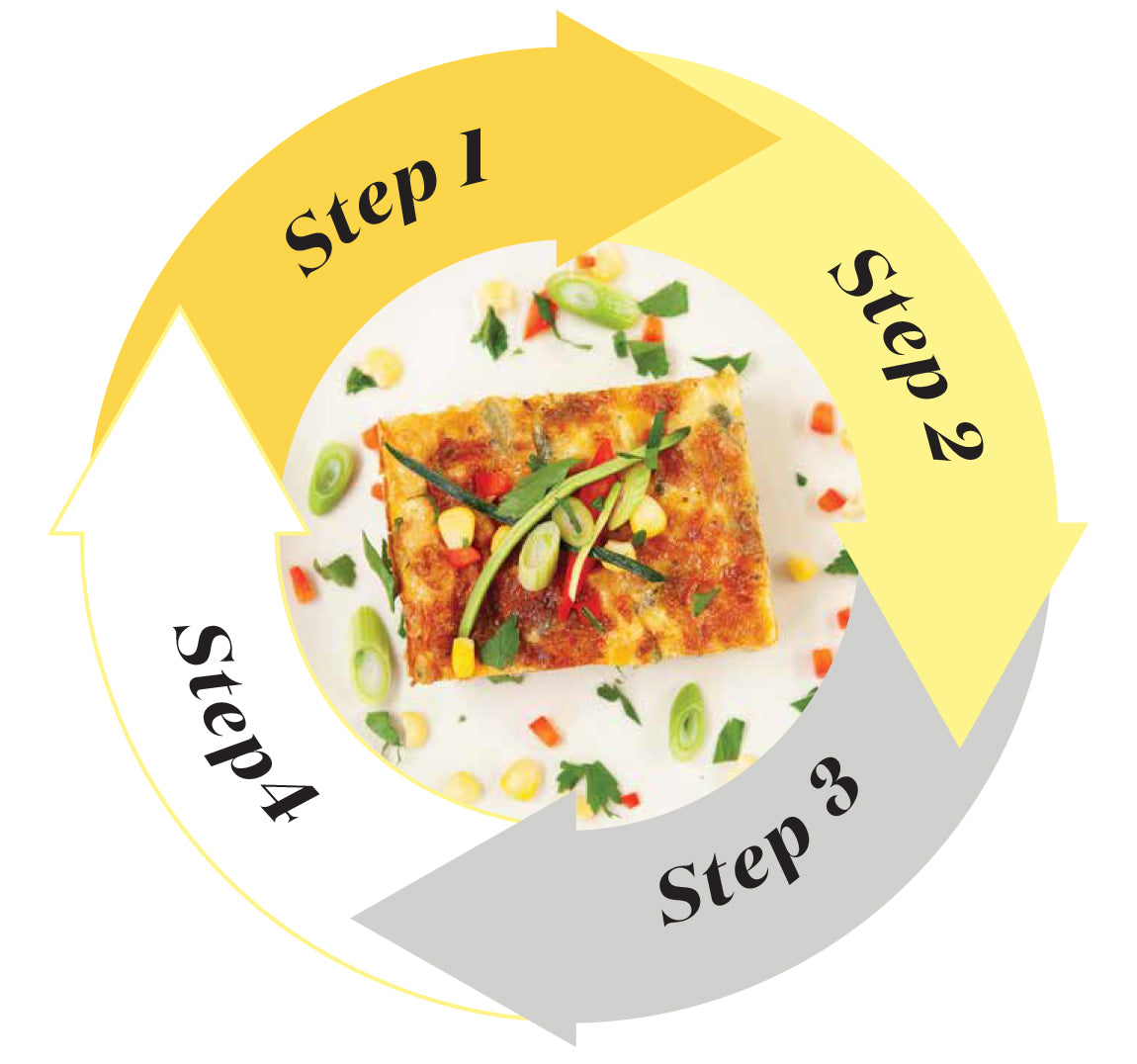
The approach is structured in four steps, and you can complete all four or begin at whichever step suits your lifestyle. You can return to Step 1 at any point for the rapid weight loss reset, and a Step 1 reset each season is recommended, citing benefits for long term maintenance and overall health. Higher calorie programs are available for people with greater energy needs.
Dietitian support
Complimentary guidance from the Accredited Practising Dietitian team is included with all meals and programs, and face to face consultations are available from the Victorian retail locations. The free consultation runs for 15 minutes by video or phone, is valued at $49, and needs no referral. Appointments can be made online or by calling 1300 263 257, Monday to Friday, 9:00am to 5:00pm.
Background and ordering
Be Fit Food was created in 2015 by a doctor and dietitian team — a bariatric surgeon and a clinical dietitian working in weight loss — after decades of clinical experience with wholefood diets. The result is described as the only real-food very low calorie diet (VLCD) available in Australia. Meals are sold in bundles: 7 meals for $97.30, 14 meals for $189.00 and 28 meals for $362.60. Delivery is a flat rate Australia-wide, $11.95 on orders of $299 or more and $19.95 below that.
What the trial evidence actually shows
The claims above are Be Fit Food's own. There is, unusually for this market, a published randomised controlled trial that tests them directly — and it is worth reading carefully, because it supports some of the claims and not others.
Researchers at Deakin University's Food & Mood Centre ran a randomised controlled trial comparing a whole-food weight-loss program using Be Fit Food meals against a supplement-based diet of shakes, soups and bars. It was published in Cell Reports Medicine. Both arms were matched for energy at roughly 800–900 calories per day and matched for macronutrients, so any difference between them could be attributed to the form of the food rather than to how much was eaten.
On weight loss, the two were comparable
After three weeks, both groups lost a similar amount of weight. This is the finding that matters most for anyone choosing between the two approaches, and it cuts against the strongest version of the marketing claim: on the specific question of how much weight comes off, real food did not beat shakes. Matched calories produced matched results.
So a claim that Be Fit Food produces more weight loss than a shake-based program is not supported by this trial. What the trial supports is that you do not have to give up real food to get the same weight result — which is a different, and more defensible, proposition.
On everything else, the differences were substantial
- Gut microbial diversity. The whole-food group recorded a significantly greater increase in microbial diversity — reported as around 40% greater — and an increase in species richness averaging roughly 28 additional species. The supplement group showed a small, statistically non-significant decrease.
- Beneficial bacteria. The whole-food group maintained higher levels of fibre-degrading bacteria including Lachnospira, which is associated with short-chain fatty acid production. These fell in the supplement group.
- Tolerability. The supplement group reported more than twice as many adverse events — 19 against 8 — most commonly headaches, bloating and constipation. The whole-food group reported fewer digestive complaints and a small improvement in bowel regularity.
How to read this honestly
Three weeks is a short trial. It tells you about the early phase of a very low calorie program, not about weight maintained at one year, and it does not establish long-term health outcomes from the microbiome differences it observed. Microbial diversity is an intermediate measure — a plausible marker of gut health rather than a clinical endpoint in itself.
What it does establish is reasonably clear. If your only criterion is kilograms lost in the first few weeks, the evidence does not favour one approach over the other. If tolerability, fibre intake, digestive comfort and the gut microbiome matter to you — or if the practical question is which approach you can actually stay on — the trial gives real reasons to prefer food you chew.
The claim on this page that the programs deliver 1–2.5kg per week should be read against that context: it is a range Be Fit Food publishes, individual results vary considerably, and the rate of loss in the early weeks of any very low calorie program includes a substantial amount of water and glycogen rather than fat alone.
Important health information
This page does not itself carry a medical disclaimer. The programs described are very low calorie diets, and Be Fit Food's stated position is that complimentary dietitian advice is available to help you choose a suitable program for your circumstances. If you are considering a rapid weight loss program, book a free consultation with the dietitian team on 1300 263 257 or at dietitian@befitfood.com.au before you begin.
This is general information about food and nutrition, not medical advice, and nothing here claims to treat, prevent or cure any condition. Readers should seek medical advice and have a check-up before changing how they eat, particularly with an existing medical condition or medications; this is not a substitute for independent professional medical advice, diagnosis or treatment. Weight loss results and rates of weight loss vary between individuals.
Related pages on this site
- Quiz — page
- Ramsayhealth — page
- Rapid Weight Loss — page
- Ready Made Meals — page
- Recipes Be Fit Food — page
- Recovery Lab 12 Week Challenge — page
Images on This Page
-
https://befitfood.com.au/cdn/shop/files/extended_logo_-_eat_yourself_better.jpg?v=1613537104
Be Fit Food
-
https://befitfood.com.au/cdn/shop/files/Untitled_design_33.png?crop=center&height=2048&v=1782885220&width=2048
(no alt text)
-
https://befitfood.com.au/cdn/shop/files/030Befit.jpg?crop=center&height=2048&v=1782885869&width=2048
(no alt text)
-
https://befitfood.com.au/cdn/shop/files/Fudgy_chocolate_brownies_with_walnuts.png?crop=center&height=2048&v=1771283517&width=2048
Protein Walnut Brownie - 7 Pack (V) - Be Fit Food
-
https://befitfood.com.au/cdn/shop/files/Untitled_design_33.png?v=1782885220&width=360
(no alt text)
-
https://befitfood.com.au/cdn/shop/files/030Befit.jpg?v=1782885869&width=360
(no alt text)
-
https://befitfood.com.au/cdn/shop/files/Fudgy_chocolate_brownies_with_walnuts.png?v=1771283517&width=360
Protein Walnut Brownie - 7 Pack (V) - Be Fit Food
-
https://cdn.shopify.com/s/files/1/0043/9743/2921/t/64/assets/pf-cdea85ce--VLCDMealComparison-Edited-Edited.jpg?v=1629078874
(no alt text)
-
https://cdn.shopify.com/s/files/1/0043/9743/2921/t/64/assets/pf-d88d0087--1.jpg?v=1627014755
(no alt text)
-
https://cdn.shopify.com/s/files/1/0043/9743/2921/t/64/assets/pf-8d0087cb--2.jpg?v=1627014808
(no alt text)
-
https://cdn.shopify.com/s/files/1/0043/9743/2921/t/64/assets/pf-a36a3526--3-Edited?v=1627014199
(no alt text)
-
https://cdn.shopify.com/s/files/1/0043/9743/2921/t/64/assets/pf-9f15a36a--4-Edited?v=1627013964
(no alt text)
-
https://cdn.shopify.com/s/files/1/0043/9743/2921/files/Real-Food.jpg?v=1627216526
(no alt text)
-
https://cdn.shopify.com/s/files/1/0043/9743/2921/files/Shakes_no_line.jpg?v=1627600243
(no alt text)
-
https://cdn.shopify.com/s/files/1/0043/9743/2921/t/64/assets/pf-52264c0f--IconsHomepage1.png?v=1603765112
(no alt text)
-
https://cdn.shopify.com/s/files/1/0043/9743/2921/t/64/assets/pf-bc5e9bee--IconsHomepageMetabolism.png?v=1604010688
(no alt text)
-
https://cdn.shopify.com/s/files/1/0043/9743/2921/t/64/assets/pf-e5928868--IconsHomepage3.png?v=1603765072
(no alt text)
-
https://cdn.shopify.com/s/files/1/0043/9743/2921/t/64/assets/pf-7a2ce592--IconsHomepage2.png?v=1603765068
(no alt text)
-
https://cdn.shopify.com/s/files/1/0043/9743/2921/t/64/assets/pf-f3677a79--IconsHomepage7.png?v=1603765096
(no alt text)
-
https://cdn.shopify.com/s/files/1/0043/9743/2921/t/64/assets/pf-7a795226--IconsHomepage8.png?v=1603765099
(no alt text)
-
https://cdn.shopify.com/s/files/1/0043/9743/2921/t/64/assets/pf-8868fa36--IconsHomepage4.png?v=1603765078
(no alt text)
-
https://cdn.shopify.com/s/files/1/0043/9743/2921/t/64/assets/pf-868cf367--IconsHomepage6.png?v=1603765089
(no alt text)
-
https://cdn.shopify.com/s/files/1/0043/9743/2921/t/64/assets/pf-e7e41208--5beforeandafter.jpg?v=1625100150
(no alt text)
-
https://cdn.shopify.com/s/files/1/0043/9743/2921/t/64/assets/pf-e4120825--14beforeandafter.jpg?v=1625100156
(no alt text)
-
https://cdn.shopify.com/s/files/1/0043/9743/2921/t/64/assets/pf-fa1d28f1--RebeccaBeforeAfter.jpg?v=1625101325
(no alt text)
-
https://cdn.shopify.com/s/files/1/0043/9743/2921/t/64/assets/pf-cd7fc904--StepCircle.jpg?v=1627454356
(no alt text)
-
https://cdn.shopify.com/s/files/1/0043/9743/2921/t/64/assets/four-steps-1634249905935.png?v=1634249909
(no alt text)
-
https://cdn.shopify.com/s/files/1/0043/9743/2921/t/64/assets/pf-4acdea85--infographicChart.jpg?v=1628833265
(no alt text)
-
https://cdn.shopify.com/s/files/1/0043/9743/2921/t/64/assets/pf-b532c4b3--KateGeoff.jpg?v=1627454058
(no alt text)
-
https://cdn.shopify.com/s/files/1/0043/9743/2921/t/64/assets/pf-f1614549--Screenshot-20201218-105849.jpg?v=1608249635
(no alt text)
-
https://befitfood.com.au/cdn/shop/files/BFF-Header-Logo.png?v=1613683757&width=400
(no alt text)